Day 11 From Signal to Capability: Why Access Must Enable Interpretation


Day 11

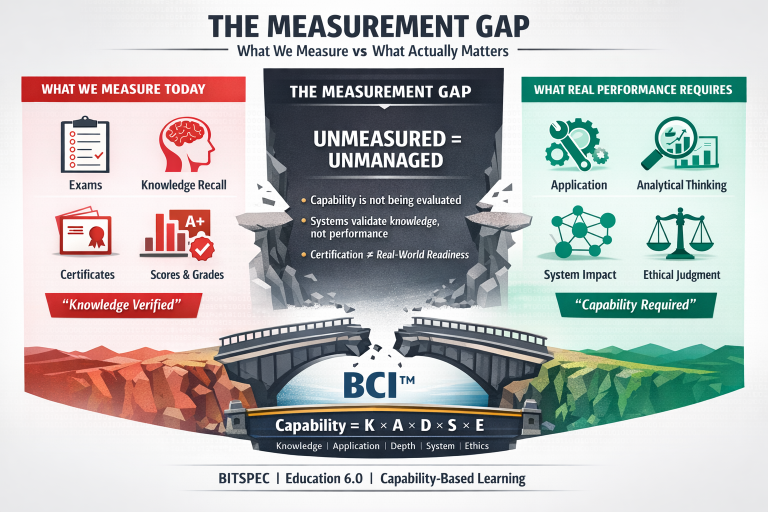
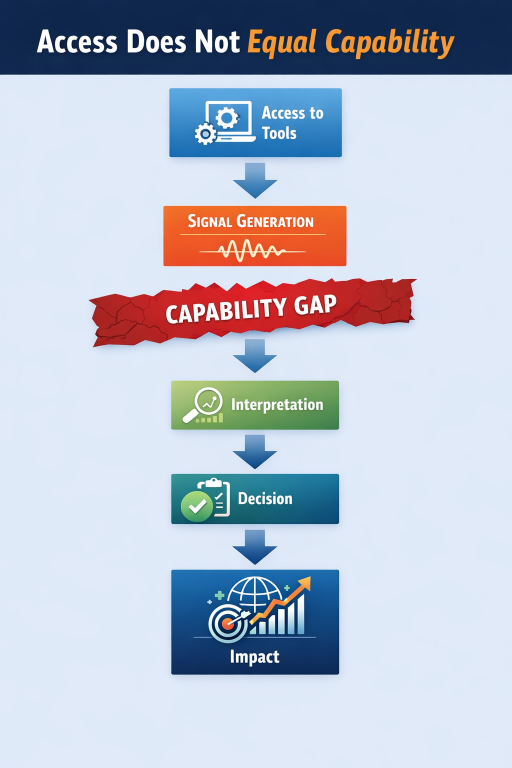
Fig. 1 Generated with ChatGPT version 5.3


  1. Introduction: The Misunderstood Problem

In modern learning and professional environments, access to advanced tools has significantly improved. From AI platforms to analytical software, organizations and learners now operate in highly capable digital environments. This progress has led to a common assumption: if access is available, capability will follow.

The problem is not access, and it is not the signal. The problem is the interpretation of the signal.

  1. Signal in Design of Experiments (DOE)

In Design of Experiments, a signal represents a real effect of a factor on a response. Modern tools are highly effective at identifying these signals through statistical testing, ANOVA, and model estimation.

In most cases, the signal is correctly identified.

Where Capability Is Required

Once a signal is detected, the challenge shifts to interpretation, understanding whether the signal is meaningful, practically significant, and applicable in real conditions.

The Risk: Misinterpretation of Signals

  • Statistical vs practical confusion
  • Ignoring interactions
  • Context misalignment
  • Overconfidence in outputs

Correct signals can lead to incorrect decisions if misinterpreted.

  1. The Role of Access

Access to tools is essential. Without access, no analysis can be performed, and no applied learning can occur.

Access enables signal generation, not signal understanding.

Access to Software: A Structural Constraint on Capability

  1. The Core Issue

Modern capability development depends on access to software and digital tools. Without access, capability cannot be developed.

  1. The Structural Contradiction

Access to tools is often controlled through licensing, pricing models, and sales channels. This creates a contradiction: capability depends on access, but capability requirements do not govern access.

  1. The Confrontation

A salesperson or commercial channel should not determine who can develop capability in a method that depends on access to a tool.

When access to essential tools is controlled outside the education system, capability formation becomes externally constrained.

  1. Why This Matters?

When access is inconsistent or restricted, learning becomes fragmented and capability development uneven.

  1. Enterprise Implication

If organizations do not control access to the tools required for learning, they do not fully control capability development.

  1. Education System Implication

Teaching methods that depend on tools require guaranteed and sustained access to those tools.

  1. Global Implication

Digital inclusion must include access to the specific tools required to build real capability.

  1. Structured Principle

Access to software essential for capability must be treated as an educational requirement, not only a commercial transaction.

  1. Conclusion

A single misinterpreted signal, embedded within flawed assumptions, can sustain an entire system of decisions that is statistically coherent yet fundamentally incorrect.

  1. Final Reflections

Access enables signals. Education enables interpretation. Capability enables correct decisions. Verification enables trust.

Digital inclusion must evolve beyond connectivity and platform access.
It must ensure equitable and sustained access to the tools required to develop verifiable human capability.

Access opens the door to participation.
Education shapes understanding beyond entry.
Capability transforms knowledge into performance.
Verification anchors that performance in trust.

But when access is filtered through commercial interests, division is reinforced, and entire groups remain excluded from capability development.

The future of education is not defined by access alone, but by access aligned with equitable and verifiable capabilities.

An article blog written with ChatGPT version. 5.3 support April 13, 2026
 

Continue reading
  174 Hits

Day 10 The Illusion of Intelligence: Why AI Does Not Guarantee Capability

From Artificial Intelligence to Verified Capability (Education 6.0 Perspective)


Day 10

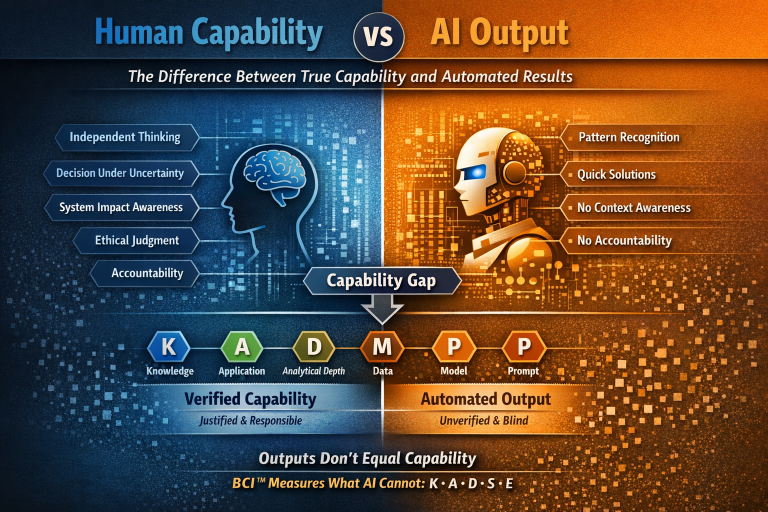
Fig. 1 Generated with ChatGPT version 5.3

Abstract

Artificial Intelligence is rapidly transforming education, certification, and professional practice. However, its increasing presence introduces a critical misconception: that access to AI equates to competence. This article examines the structural gap between AI-generated outputs and human capability, arguing that intelligence without verification creates systemic risk. Within the Education 6.0 framework, AI is positioned not as a substitute for competence but as a multiplier—one that must be governed, measured, and verified through the BITSPEC Capability Index (BCI™).

1. The Rise of AI – A False Signal of Competence

AI tools today can:

  • Generate reports, analyses, and code

  • Solve statistical problems instantly

  • Draft policies, frameworks, and strategies

  • Simulate expert-level reasoning

At first glance, this creates the appearance of capability.

But appearance is not capability.

AI produces outputs. Capability requires ownership, judgment, and accountability.

A student using AI can submit a perfect assignment. A professional using AI can produce a flawless report.

Yet neither guarantees:

  • Understanding

  • Transferability of knowledge

  • Ethical decision-making

  • System impact awareness

This is the Illusion of Intelligence.

2. AI as a Function, Not a Capability

At its core, AI behaves as a function:

Output = f(Data, Model, Prompt)

This means:

  • AI depends entirely on input quality

  • It operates within probabilistic boundaries

  • It has no intrinsic responsibility

In contrast, human capability includes far more than output generation.

3. What Is Human Capability? (Education 6.0 Definition)

Human capability is not knowledge, nor performance alone.

Human capability is the sustained ability to make justified, responsible, and effective decisions under real-world conditions.

It is demonstrated when an individual can:

1. Think Independently
  • Interpret context beyond given data

  • Challenge assumptions (including AI outputs)

  • Form original reasoning

2. Act Under Uncertainty
  • Make decisions with incomplete or imperfect information

  • Accept and manage risk

  • Move forward without full certainty

3. Sustain Performance Under Pressure
  • Maintain quality of thinking in complex situations

  • Avoid collapse when the stakes are high

  • Remain consistent over time

4. Understand System Impact
  • Recognize downstream consequences

  • Evaluate financial, operational, and societal effects

  • Connect decisions to broader systems

5. Exercise Ethical Judgment
  • Make responsible decisions when trade-offs exist

  • Identify bias, misuse, or unintended harm

  • Act with integrity even when not enforced

6. Own Decisions and Outcomes
  • Take responsibility for results

  • Justify decisions clearly

  • Remain accountable when outcomes fail

Critical Insight

Capability is not what a person can produce once. It is what they can consistently justify, sustain, and take responsibility for.

4. The Hidden Risk: Delegated Thinking

The most dangerous shift is not AI itself; it is unverified delegation of thinking. When individuals rely on AI without verification:

  • Errors are amplified, not reduced

  • Bias is embedded invisibly

  • Decisions lose traceability

  • Accountability becomes unclear

This leads to:

High-quality outputs with low-quality understanding

5. Why Traditional Certification Fails in the AI Era

Traditional systems assume:

  • Work submitted = work understood

  • Correct answers = competence

  • Completion = readiness

AI breaks all three.

Certification verifies outcomes, not capability.

A candidate can pass exams, complete assignments, and obtain certification without demonstrating:

  • Independent thinking

  • System awareness

  • Ethical responsibility

  • Sustained performance

6. How Capability Is Verified Today – And Why It Fails
Current Methods
  • Academic credentials

  • Professional certifications

  • Work experience

  • Portfolio evidence

The Core Assumption

If outputs are correct, capability exists.

This assumption no longer holds.

The Verification Gap

Traditional systems validate:

What was produced

But fail to validate:

  • How it was produced

  • Why were decisions made

  • What risks were considered

  • What impact was evaluated

  • Who is accountable

This results in:

Verification without traceability

7. The Collapse of Trust Signals

Degrees, certifications, and experience once acted as reliable signals.

Today:

  • AI equalizes output quality

  • Capability becomes indistinguishable

  • Weak performers can appear strong

This is signal dilution.

8. What True Verification Requires

To verify human capability, systems must assess:

Decision Traceability

Can the individual explain their reasoning?

Analytical Integrity

Are conclusions logically derived?

System Awareness

Are consequences understood?

Ethical Justification

Are decisions responsible?

Independence of Thought

Can AI outputs be challenged?

9. The Role of BCI™ in an AI-Augmented World

The BITSPEC Capability Index (BCI™) provides a structured verification model:

BCI = (K × A × D × S × E)^(1/5)

Where:

  • K – Knowledge

  • A – Application

  • D – Analytical Depth

  • S – System Impact

  • E – Ethical Judgment

Key Insight

AI can support:

  • Knowledge access

  • Execution assistance

  • Analytical suggestions

But it cannot guarantee:

  • Real-world consequences (S)

  • Ethical responsibility (E)

  • Accountability

10. AI + Human = Augmented Capability (Only If Verified)

AI should not replace capability; it should expose it.

A capable individual must demonstrate:

  • How AI was used

  • Why were decisions made

  • What risks were identified

  • What impact is expected

  • What ethical considerations were evaluated

11. The New Competency: AI Governance

A new foundational capability emerges:

AI Governance
  • Prompt awareness

  • Output validation

  • Bias detection

  • Decision traceability

  • Ethical boundaries

12. From Intelligence to Accountability

AI can generate answers.

But only humans can:

  • Take responsibility

  • Accept consequences

  • Make ethical decisions

Capability is defined by accountability not intelligence.

13. The Future of Verification Systems

Future systems must be:

  • Evidence-based

  • Process-aware

  • AI-transparent

  • Continuously validated

Capability must be demonstrated, not declared

14. Conclusion: The Future is Not AI – It is Verified Capability

AI is not the endpoint; it is the amplifier.

The real question is not:

“Can AI do this?”

But:

Can the human behind AI justify, validate, and own the outcome?

Education 6.0 answers this by shifting from:

  • Intelligence → Capability

  • Output → Evidence

  • Certification → Verification

Final Statement

AI can generate answers. Only human capability can justify them.

An article blog written with ChatGPT version. 5.3 support April 10, 2026

Continue reading
  263 Hits

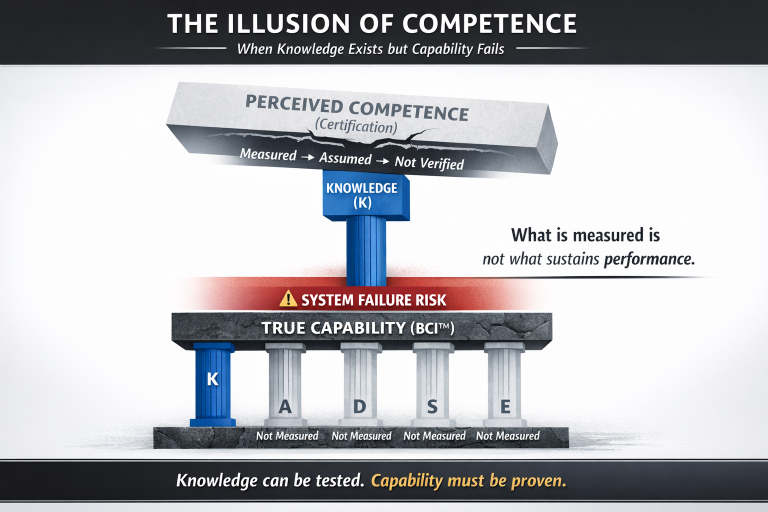
Day 9 — The Illusion of Competence: When Knowledge Exists but Capability Fails

Day 9

Fig. 1 Generated with ChatGPT ver. 5.3

Abstract

Modern education and certification systems have optimized for what is easy to measure: knowledge. Exams, quizzes, and credentials provide the appearance of competence, yet real-world failures continue to occur across engineering, healthcare, manufacturing, and governance. This article argues that the root cause is not a lack of knowledge, but a systemic inability to measure and verify true capability. Through the BITSPEC Capability Index (BCI™), we demonstrate that competence is multidimensional and cannot be reduced to knowledge alone. The failure to recognize this distinction has created a global illusion of competence, one that carries significant operational, ethical, and societal risks.

1. Introduction: The Comfort of Knowing

We live in a world that equates knowledge with competence.

A student passes an exam.
A professional earns a certification.
An organization hires based on credentials.

And from these signals, we conclude:

This person is capable.

Yet reality tells a different story.

Systems fail.
Processes break down.
Decisions lead to unintended consequences.

Not because knowledge is absent, but because capability was never truly verified.

2. The Systemic Bias Toward Knowledge

Knowledge is overvalued for one simple reason:

It is easy to measure.

Standardized tests, multiple-choice exams, and theoretical assessments allow institutions to scale evaluation efficiently. These tools provide clear scores, rankings, and pass/fail decisions.

But what do they actually measure?

  • Recall
  • Recognition
  • Conceptual familiarity

They do not measure:

  • Real-world application
  • Decision-making under uncertainty
  • System-level impact
  • Ethical judgment

As a result, modern systems have unintentionally optimized for what is measurable rather than what is meaningful.

3. Certification and the Assumption of Competence

Certification has become a proxy for trust.

A certificate suggests that an individual has met a defined standard. Employers rely on it. Institutions promote it. Professionals pursue it.

But certification often follows a linear logic:

Knowledge → Exam → Certificate → Assumed Competence

This model contains a critical flaw:

It assumes that knowledge, once demonstrated in isolation, will translate into performance in complexity.

In reality, this assumption frequently breaks.

4. The Multidimensional Nature of Capability

True capability is not linear. It is systemic.

At BITSPEC, capability is defined through the BCI™ (BITSPEC Capability Index), which integrates five dimensions:

  • Knowledge (K) — What a person knows
  • Application (A) — What a person can do
  • Analytical Depth (D) — How deeply a person understands and interprets
  • System Impact (S) — The effect of decisions within a broader system
  • Ethical Judgment (E) — The ability to act responsibly, especially under uncertainty

These dimensions are not additive—they are interdependent.

If any one dimension collapses, capability collapses.

A professional with strong knowledge but weak ethical judgment can cause systemic harm.
A practitioner with application skills but no system awareness may optimize locally while damaging the whole.

Capability, therefore, must be proven across all dimensions.

5. The Rise of the “Confident but Incomplete” Professional

One of the most dangerous outcomes of the current system is the emergence of individuals who are:

  • Highly knowledgeable
  • Formally certified
  • Operationally unprepared

These professionals are not incompetent in the traditional sense. They are incomplete.

They:

  • Trust their knowledge without questioning its limits
  • Apply tools without understanding system consequences
  • Operate without fully considering ethical implications

This creates a new risk category:

The confident but incomplete professional

Such individuals do not appear as risks on paper—yet they are often at the center of real-world failures.

6. Evidence Across Industries

This pattern is observable across sectors:

Engineering

Systems fail despite teams being “qualified.”
Root causes often trace back to misapplied knowledge or a lack of systems thinking.

Healthcare

Protocols are followed, yet patient outcomes suffer.
The issue is not ignorance but misinterpretation of context.

Manufacturing

Technicians encounter complex machine failures that they cannot resolve.
Training exists—but capability does not extend to complexity.

Governance and Policy

Decisions are made based on models that ignore ethical and systemic implications.
The result is long-term societal impact driven by short-term reasoning.

Across all cases:

The gap is not knowledge.
The gap is in capability validation.

7. Education’s Role in Creating the Illusion

Education systems did not intend to create this illusion—but they enabled it.

Over time, three assumptions became embedded:

  • Passing = competence
  • Certification = trust
  • Knowledge = capability

These assumptions were never fully validated.
They were simply scaled.

As a result, we now operate within a system where:

Performance is assumed, not proven.

8. The BCI™ Perspective — From Measurement to Verification

The BCI™ model reframes the problem:

Capability is not what a person knows.
Capability is what a person consistently demonstrates across conditions.

This requires:

  • Integrated assessment (not isolated testing)
  • Real-world application evidence
  • System-level evaluation
  • Ethical validation

The BCI™ formula expresses this interdependence:

BCI = (K × A × D × S × E)^(1/5)

This structure ensures that:

  • No single strength can compensate for a critical weakness
  • Capability reflects balance, not specialization alone
  • Verification replaces assumption
9. An Artistic Reflection — Capability That Endures

Before modern certification systems, mastery was not declared—it was demonstrated.

In art, architecture, and craftsmanship:

  • There were no standardized exams
  • No multiple-choice validation
  • No rapid certification cycles

Instead:

The work itself became the proof.

The sculptures of Michelangelo still stand today not as credentials, but as evidence of capability.

Time became the ultimate verifier.

In contrast, today’s certifications often expire within years, while the systems built by “certified professionals” may fail within months.

This contrast raises a fundamental question:

Have we replaced proof with perception?

10. Conclusion: The Risk of Measuring the Wrong Thing

We are not failing because people lack knowledge.

We are failing because:

  • We measure what is easy
  • We certify what is convenient
  • We assume what has not been verified

The result is a system that produces:

  • Qualified individuals
  • Certified professionals
  • Unverified capability
Final Statement

Knowledge can be tested. Capability must be proven.

Closing Reflection

If we continue to equate knowledge with capability, we will continue to produce systems that look correct but fail in reality.

The future of education, certification, and professional trust depends on a fundamental shift:

From measuring knowledge→ to verifying capability

Only then can competence move from illusion to truth.

An article blog written with ChatGPT version. 5.3 support April 9, 2026

Continue reading
  218 Hits

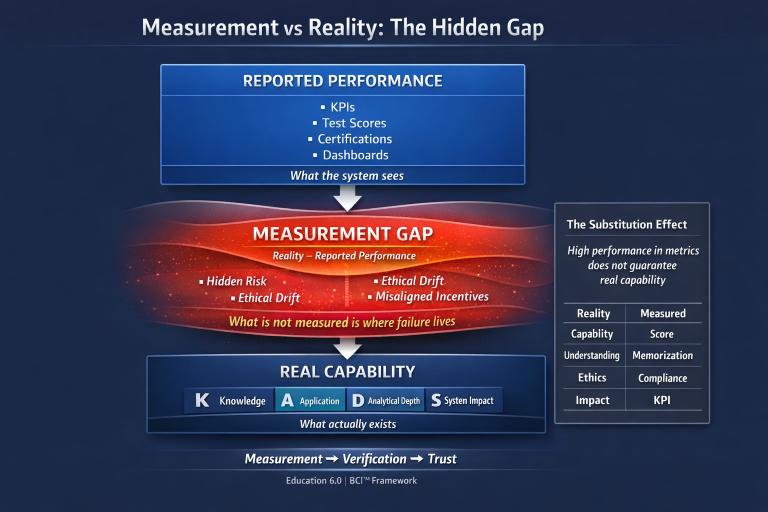
Day 8 — The Illusion of Measurement: When Metrics Replace Reality

Day 8

Fig. 1 Generated with ChatGPT ver.5.3 instant


1. Introduction

Modern systems are built on measurement.

We measure performance, learning, productivity, quality, risk, and compliance. We design dashboards, define KPIs, administer exams, and issue certifications—all in the pursuit of control, improvement, and assurance.

Measurement gives us comfort.

It creates the impression that what we observe is what truly exists.

But this assumption is flawed.

What gets measured is not always what exists.
And what exists is not always what gets measured.

This is the illusion of measurement—and it is one of the most dangerous weaknesses in modern professional, educational, and organizational systems.

2. The Measurement Comfort Trap

Measurement creates psychological stability.

A score, a metric, or a certification suggests:

  • Objectivity
  • Control
  • Validity
  • Completion

Organizations rely on these signals to make decisions. Individuals rely on them to define competence. Institutions rely on them to claim credibility.

But measurement does not guarantee truth.

It only reflects what has been chosen to be measured.

And what is chosen is often driven by:

  • Convenience
  • Standardization
  • Cost
  • Visibility

Not by reality.

3. The Substitution Effect

Over time, a subtle shift occurs.

Measurement stops being a representation of reality and becomes a substitute for it.

Reality
What is Measured

Capability

Test scores

Understanding

Memorization

Ethical judgment

Compliance checklists

System impact

Short-term KPIs


This substitution creates a dangerous illusion:

If it is measured, it must be true.

But what is measured is often only a fragment of the whole.

And fragments, when mistaken for completeness, become distorted.

4. Why Measurement Fails

Measurement systems fail not because they are incorrect, but because they are incomplete.

Three fundamental forces drive this failure:

1. Human Optimization

People optimize for what is rewarded.

If success is defined by passing a test, individuals will learn how to pass the test, not necessarily how to perform in reality.

2. System Visibility Bias

Organizations prioritize what can be easily measured.

Complex elements such as:

  • Ethical reasoning
  • System thinking
  • Long-term impact

They are often excluded because they are difficult to quantify.

3. Reduction of Complexity

Reality is multi-dimensional. Measurement simplifies it.

But simplification removes:

  • Context
  • Interdependencies
  • Consequences

What remains is a controlled but incomplete representation of performance.

5. The Measurement Gap

Between reality and reported performance lies an invisible space:

Measurement Gap = Reality – Reported Performance

This gap is where:

  • Risks accumulate
  • Ethical drift begins
  • Poor decisions are justified
  • System failures are born

It is not the visible metrics that create failure—it is what remains unseen.

Organizations rarely collapse because of what they measure.

They collapse because of what they ignore.

From Measurement to Capability: The BCI™ Perspective

Traditional systems focus heavily on knowledge.

They measure:

  • What a person knows
  • What a person can recall

But professional capability is far more complex.

The BITSPEC Capability Index (BCI™) introduces a multi-dimensional model:

  • K — Knowledge
  • A — Application
  • D — Analytical Depth
  • S — System Impact
  • E — Ethical Judgment

The capability is defined as:

BCI = (K × A × D × S × E)^(1/5)

This formulation introduces a critical principle:

Capability is not additive—it is multiplicative.

A high score in one dimension cannot compensate for failure in another.

A professional with strong knowledge but weak ethical judgment or system awareness does not represent partial competence.

They represent systemic risk.

6. The Art Perspective: Proof Through Time

Before modern measurement systems, capability was not validated through scores.

It was validated through creation.

  • Cathedrals stood for centuries
  • Engineering structures endured generations
  • Works of art carried meaning across time

These outputs were not certified.

They were verified through durability, impact, and continuity.

The work itself became the proof.

In contrast, modern systems often certify before reality has the opportunity to validate.

This reversal creates a disconnect between recognition and truth.

7. The Critical Shift: From Measuring to Verifying

Measurement alone is insufficient.

Verification must follow.

Measurement answers:

  • What was achieved within controlled conditions

Verification answers:

  • What performs under real conditions

Measurement is static.

Verification is dynamic.

Measurement observes.

Verification proves.

This is the missing layer between certification and trust.

8. Implications for Modern Systems

The illusion of measurement has far-reaching consequences:

  • Education systems produce graduates who pass exams but struggle in practice
  • Organizations optimize KPIs while losing long-term capability
  • Certifications signal competence without proving performance
  • Ethical failures emerge in areas that were never measured

Without addressing the measurement gap, systems continue to operate under false confidence.

9. Conclusion

Measurement is necessary—but it is not sufficient.

When metrics replace reality, systems become vulnerable not because they lack data, but because they misunderstand it.

The true challenge is not to measure more.

It is to measure what matters—and verify what cannot be measured.

The greatest risk is not that we fail to measure.
It is that we measure the wrong thing—and believe it is the truth.

BITSPEC Education 6.0 Position

Education 6.0 moves beyond measurement.

It establishes:

  • Capability over completion
  • Verification over certification
  • Systems thinking over isolated metrics

Through the BCI™ model, capability becomes:

  • Observable
  • Measurable across dimensions
  • Verifiable in context

Because in the end:

Trust is not built on what is measured.
It is built on what is proven.

An article blog written with ChatGPT version. 5.3 support April 8, 2026

Continue reading
  212 Hits

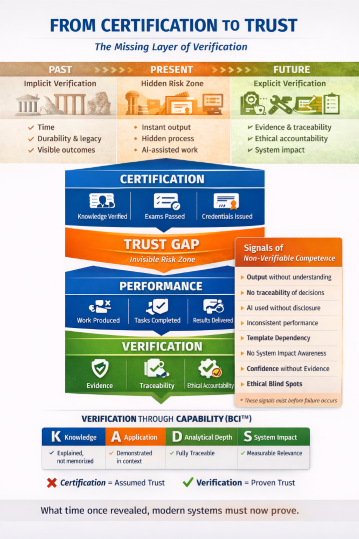
Day 7 From Certification to Trust: The Missing Layer of Verification

Day 7

Fig. 1- generated with ChatGPT ver.5.3 instant


Abstract

Certification has become the dominant signal of competence. It is also insufficient.
In complex, AI-mediated systems, knowledge can be simulated, outputs can be generated, and performance can be imitated—without underlying capability.

This creates a structural problem: trust is assumed where it cannot be verified.

This article establishes a critical distinction: certification validates exposure; verification validates capability. It introduces verification as the missing layer in professional systems and positions capability as a measurable, evidence-based construct.

1. Certification Is Not Trust

Certification confirms that a person has met predefined criteria.
It does not confirm that the person can perform under real conditions.

The modern certification model is built on:

  • Examination
  • Completion
  • Standardization

None of these guarantees:

  • Transferability
  • Accountability
  • Integrity under complexity

Certification produces confidence.
It does not produce trust.

2. When Time Was the Verifier

Before certification systems, capability was not declared—it was revealed.

In architecture, engineering, and art, the result of work persisted beyond its creator.
Structures stood or collapsed.
Systems functioned or failed.
Art endured or disappeared.

There was no external validation layer.
Time performed the verification.

Time exposed:

  • Weak design
  • Poor understanding
  • Lack of responsibility

And it preserved:

  • Precision
  • mastery
  • integrity

Verification was not immediate. But it was absolute.

3. The Loss of Temporal Verification

Modern systems have eliminated time as a reliable validator.

  • Outputs are instantaneous
  • Work is digital
  • Systems are opaque
  • AI can generate results without understanding

Failure no longer appears gradually. It is either delayed or completely hidden.

This creates a fundamental shift: Capability is no longer revealed by time. It must be established by design.

4. The Trust Gap

Between certification and real-world performance lies an unmeasured space:

 The trust gap exists when:

  • Output is present, but reasoning is absent
  • Results exist, but the process is invisible
  • Decisions are made, but accountability is unclear

The gap is not theoretical. It is operational.

Organizations experience it as:

  • inconsistent performance
  • unexplainable outcomes
  • systemic failure under stress
5. AI as an Amplifier

Artificial intelligence does not create the trust gap.
It scales it.

AI enables:

  • rapid output generation
  • high-quality language and analysis
  • replication of expert patterns

But it does not guarantee:

  • understanding
  • responsibility
  • ethical judgment

AI separates output from capability. This makes verification no longer optional. It becomes foundational.

6. Verification as a System Requirement

Professional systems currently operate on two layers:

  • Knowledge
  • Application

Both are insufficient without a third layer:

Verification

Verification requires:

  • evidence of process
  • traceability of decisions
  • transparency of tools
  • accountability for outcomes

Without verification, performance remains unproven.

7. Detectable Absence of Verification

Non-verifiable capability is not hidden. It produces patterns:

  • Explanation cannot follow the output
  • Performance collapses outside templates
  • Reasoning cannot be reconstructed
  • Tools are used but not disclosed
  • The impact is not understood
  • Confidence exceeds evidence

These are not learning gaps. They are verification failures.

8. Capability as a Verifiable Structure (BCI™)

Capability must be defined in terms that can be tested, observed, and verified.

The BITSPEC Capability Index (BCI™) defines five necessary conditions:

  • Knowledge
  • Application
  • Analytical Depth
  • System Impact
  • Ethical Judgment

Capability is not additive. It is multiplicative.

If one dimension fails, the system fails.

Capability exists only when all dimensions are present and verifiable.

9. From Credentialing to Verification

The transition is structural:

 
Certification
Verification

Assumed competence

Demonstrated capability

Static validation

Continuous evidence

Knowledge-based

Multi-dimensional

No traceability

Full traceability


This is not an improvement.
It is a replacement model.

10. The New Standard

Future professional systems will not rely on claims.

They will require:

  • evidence
  • transparency
  • traceability
  • ethical accountability

Trust will no longer be granted. It will be constructed.

Conclusion

The problem is not the absence of certification. It is the absence of verification.

In the past, time revealed the truth of human capability. Today, that responsibility belongs to system design.

What time once revealed, modern systems must now prove.

An article blog written with ChatGPT version. 5.3 support April 6, 2026


Continue reading
  255 Hits

Day 6 – From Certification to Capability: The Hidden Misalignment That Drives System Failure

Day6
The Failure We Keep Observing—But Rarely Explain

Across industries, a persistent contradiction exists:

  • Systems are designed using best practices
  • Professionals are trained and certified
  • Processes are documented and controlled

Yet failure continues.

Defects persist in manufacturing.
Errors occur in healthcare systems.
Improvement initiatives deliver inconsistent or unsustainable results.

This is not a failure of effort.
It is not even a failure of knowledge.

It is a failure of alignment—a misalignment that is rarely visible and rarely verified.

The Invisible Misalignment Problem

Modern professional systems operate under an implicit assumption:

If individuals are trained, their actions will align with system needs.

This assumption is fundamentally flawed.

What is missing is the ability to verify alignment between:

  • What a professional knows
  • What a system requires
  • What a professional actually does in practice

This creates a condition we define as:

Unverified Capability Misalignment

A state where:

  • Knowledge exists
  • Action occurs
  • But the connection between them is not validated

This misalignment does not appear in exam results.
It is not visible in credentials.

It becomes visible only after failure occurs.

Why Failure Actually Happens

Failure is not random. It follows a pattern.

1. Knowledge Without Context

Professionals understand tools and methods.
However, real systems are:

  • Non-linear
  • Interdependent
  • Context-sensitive

Without context integration:

  • Tools are applied incorrectly
  • Metrics are misinterpreted
  • Local optimization replaces system optimization

Result: Technically correct decisions that are systemically wrong.

2. Application Without Depth

Execution without analytical depth leads to superficial problem-solving:

  • Root causes are approximated, not validated
  • Variability is misunderstood
  • Data is used descriptively, not inferentially

Result: Systems appear stable while underlying problems persist.

3. Decisions Without System Impact Awareness

Professionals often complete tasks correctly—but:

  • Do not evaluate downstream effects
  • Do not quantify cost or risk
  • Do not assess system-wide consequences

Result: Improvements in one area generate failures in another.

4. Action Without Ethical Verification

Data and AI increasingly support decisions.

Yet:

  • Ethical reasoning is not measured
  • Bias is not systematically evaluated
  • Responsibility is assumed

Result: Technically valid but ethically misaligned decisions.

5. The Core Issue: No Mechanism to Verify Alignment

The most critical gap is this:

Alignment between knowledge, action, and impact is never verified.

Systems measure:

  • Knowledge directly
  • Action partially

But they do not measure:

  • Depth
  • System consequences
  • Ethical correctness

Alignment is assumed—but never proven.

The Human Dimension: Where Ethics Becomes a System Variable

The most overlooked factor in system failure is not technical.

It is human.

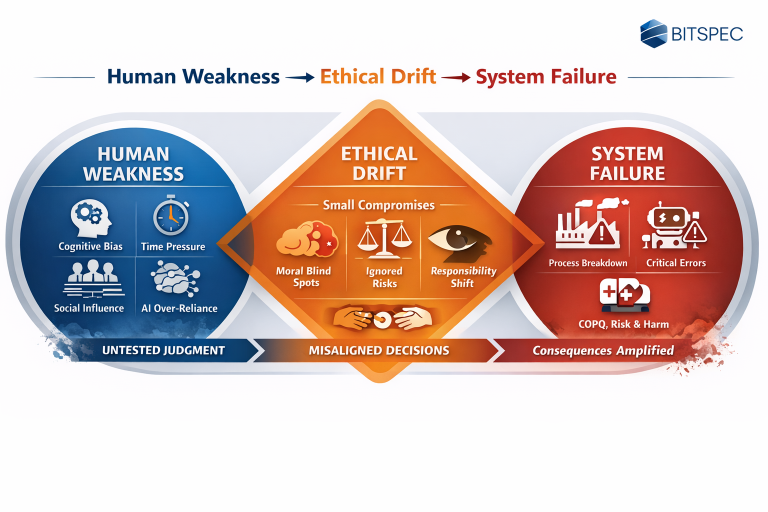
Not due to lack of intelligence—but due to the limits of human judgment under pressure, complexity, and uncertainty.

Ethics Is Not a Trait—It Is a Condition

Professional systems assume ethics are stable.

It is not.

Ethical behavior depends on:

  • Context
  • Incentives
  • Time pressure
  • Authority
  • Cognitive load
  • Technology (including AI)

Ethics is not something professionals have.
It is something that must be continuously activated and verified.

The Fragility of Ethical Judgment

Ethical drift occurs gradually:

  • Accepting assumptions without validation
  • Ignoring weak signals
  • Prioritizing speed over accuracy
  • Deferring responsibility to systems
  • Aligning with pressure instead of truth

Each step appears reasonable.

Together, they create:

A progressive erosion of ethical alignment

Cognitive Bias as a Hidden Driver

Human decision-making includes inherent biases:

  • Confirmation bias
  • Overconfidence
  • Automation bias (trusting AI blindly)
  • Authority bias

These are not exceptions—they are normal human patterns.

Without measurement, bias becomes embedded in systems.

The Illusion of Responsibility

Structured systems distribute responsibility:

  • Roles are defined
  • Processes are documented
  • Tools are approved

Yet:

When responsibility is distributed, ethical accountability disappears.

Professionals may:

  • Follow procedures
  • Meet metrics

But still contribute to failure.

Because:

Compliance is measured.
Ethical correctness is not.

AI and the Amplification of Weakness

AI accelerates decisions.

But it also introduces risk:

  • Over-reliance on outputs
  • Reduced critical thinking
  • Hidden assumptions

AI does not create ethical problems.
It amplifies existing human weaknesses.

Why Ethics Must Be Measured

Ethics is traditionally treated as:

  • Policy
  • Training
  • Declaration

Not as measurable capability.

This creates a blind spot.

To close it, ethics must become:

  • Observable
  • Assessable
  • Evidence-based

Evaluated through:

  • Decisions under uncertainty
  • Use of AI and data
  • Response to conflicting pressures
  • Consideration of system impact
The Nature of the Misalignment

This misalignment is difficult to detect because it is:

  • Distributed across decisions
  • Delayed in impact
  • Amplified by systems
  • Masked by short-term performance

By the time failure appears:

  • It is embedded
  • It is costly
  • It is often misunderstood
The BCI™ Perspective: Verifying Alignment

To address this, capability must be measured differently.

Capability = K × A × D × S × E

Where:

  • K – Knowledge
  • A – Application
  • D – Analytical Depth
  • S – System Impact
  • E – Ethical Judgment

The key shift:

Capability is not assumed—it is verified through evidence.

This ensures:

  • Knowledge connects to action
  • Action is analytically validated
  • Outcomes are system-tested
  • Decisions are ethically grounded
Failure Reframed

Failure is not unexpected.

It is the predictable outcome of:

  • Knowledge without integration
  • Action without validation
  • Decisions without system awareness
  • Systems without ethical control
  • Alignment without verification
From Invisible Misalignment to Measurable Capability

The future of professional validation must answer:

Not “What does a professional know?”
But “Are knowledge, decisions, and outcomes aligned—and verified?”

This requires:

  • Evidence-based assessment
  • Multi-dimensional evaluation
  • System accountability
  • Ethical measurement
  • Continuous validation
Conclusion: What We Must Accept

We are not facing a shortage of trained professionals.

We are facing a shortage of verified capability.

Until alignment is measurable:

  • Failures will continue
  • Improvements will remain inconsistent
  • Trust will erode

The shift required is fundamental:

From validating knowledge


To verify alignment between knowledge, action, impact, and ethics.

Only then can systems become reliable.

Only then can capability be trusted.

BITSPEC – Education 6.0: Making Capability Measurable. Making Alignment Verifiable.


An article blog written with ChatGPT version. 5.2 support April 3, 2026

Continue reading
  187 Hits

Day 5 – Reflection: From Knowledge to Capability BITSPEC – Education 6.0

1. The Illusion of Knowledge (Days 1 & 2)

Knowledge is no longer scarce—but capability is. While AI enables rapid access to information, knowing is not equivalent to doing, and doing is not equivalent to understanding. Competence must be demonstrated, not assumed.

We began with a fundamental tension: knowledge is no longer scarce, but capability is.

Access to information has never been easier. AI systems can explain, generate, and simulate knowledge at unprecedented speed. Yet, as we explored, knowing is not the same as doing, and doing is not the same as understanding.

The distinction between competence and knowledge revealed a critical flaw in traditional education systems:

  • Knowledge can be acquired quickly
  • Competence must be demonstrated over time
  • Capability requires integration across contexts

This is where most systems stop—and where failure begins.

2. The Measurement Gap (Day 3)

Traditional education measures recall and repetition. Real systems demand application, analytical reasoning, system thinking, and ethical judgment. Measurement defines reality.

If knowledge is insufficient, then how do we measure what truly matters?

Day 3 exposed the Measurement Gap—the disconnect between what education systems assess and what real-world performance requires.

Traditional systems measure:

  • Recall
  • Recognition
  • Procedural repetition

But real-world systems demand:

  • Application under uncertainty
  • Analytical reasoning
  • System-level thinking
  • Ethical judgment

This gap is not theoretical—it is operational. It explains why highly educated individuals may struggle in complex environments, and why organizations continue to face performance failures despite extensive training programs.

Measurement, therefore, is not neutral—it defines reality.


3. The Ethical Imperative (Day 4)

Day 4 introduced the need to move beyond compliance-based ethics toward embedded ethical judgment within capability.

The key insight:

A system that performs efficiently but produces harm is not competent—it is dangerous.

Ethics must be:

  • Designed into systems
  • Measured alongside performance
  • Practiced, not declared

This is particularly critical in AI-assisted environments, where decisions may be amplified, automated, and scaled beyond human oversight. Ethics must be embedded in capability. Efficient systems that produce harm are not competent—they are dangerous. Ethical judgment must be practiced and measured.

4. The Emergence of Capability

The BITSPEC Capability Index (BCI™) defines capability as the integration of Knowledge, Application, Analytical Depth, System Impact, and Ethical Judgment.

5. Education 6.0

Education must shift from knowledge delivery to capability verification. Performance, not completion, defines competence. 

We are no longer in an era of education defined by content delivery. We are entering an era defined by capability verification.

Education 6.0 is not a technological upgrade—it is a philosophical shift.

Final Reflections

We have optimized education for what is easy to measure—not what matters. Capability must be demonstrated, verified, and ethically grounded.

The challenge ahead is not to add more content, more courses, or more credentials. The challenge is to redefine what it means to be capable—and to prove it.

This is not just an educational problem.


It is a societal one.

Because in the end:

  • Systems are designed by people
  • Decisions are made by people
  • Consequences are carried by people

And if capability is not properly developed and verified, the system itself becomes the risk.

Article blog written with ChatGPT ver. 5.2 support April 2, 2026

Continue reading
  186 Hits

Day 4 The Decision Gap: Why Data-Driven Organizations Still Fail

Abstract

Organizations today operate in environments saturated with data, dashboards, and artificial intelligence. Yet, despite unprecedented access to information, poor decisions persist across industries.

This paradox reveals a critical issue: the Decision Gap—the disconnect between having data and making the right decision.

While classical decision-making models explain how humans make decisions, they do not explain why decisions fail in modern, data-rich environments.

This article extends established ethical decision-making theory by introducing the BITSPEC Capability Index (BCI™) as a measurable framework for decision quality in the era of AI and complex systems.

1. Introduction: The Illusion of Data-Driven Organizations

Modern organizations proudly claim to be data-driven.

They invest in:

  • Advanced analytics
  • AI-enabled systems
  • Real-time dashboards
  • Predictive models

Yet failures continue:

  • Strategic misalignment
  • Ineffective improvement initiatives
  • Ethical breakdowns
  • System-level inefficiencies

The problem is not lack of data.
The problem is the inability to make correct decisions from data.

2. Theoretical Foundation: How Decisions Are Traditionally Understood

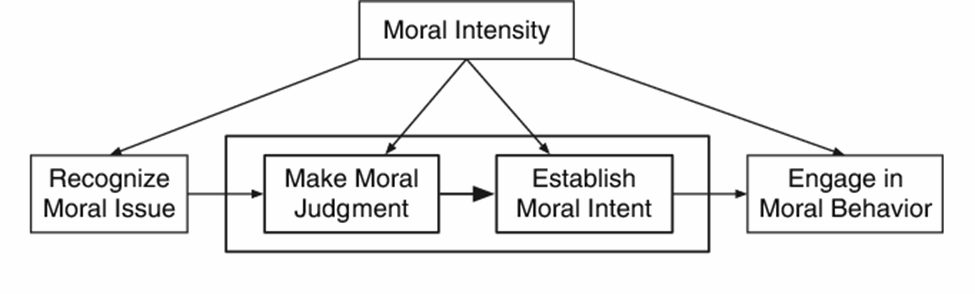
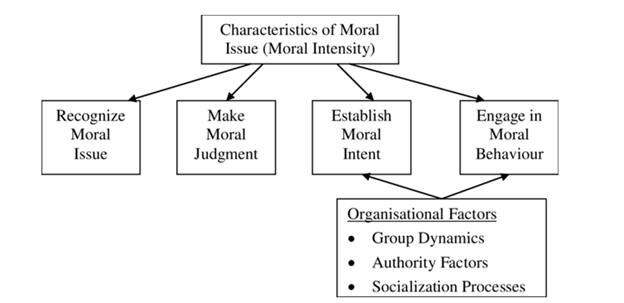
Traditional_theorerical_foundation.jpegCharacteristics


Schwartz, M.s & Kusyk, Sophia. (2017). Ethical Decision-Making Theory: Revisiting the Moral Intensity Construct. Academy of Management Proceedings. 2017. 16266. 10.5465/AMBPP.2017.16266abstract.

Classical ethical decision-making models—particularly those developed by James Rest and Thomas M. Jones—describe decision-making as a structured process:

  1. Awareness (Recognize the issue)
  2. Judgment (Evaluate what is right)
  3. Intention (Commit to action)
  4. Behavior (Act)

These models also introduce:

  • Moderating factors (individual moral capacity, situational context)
  • Internal processing (emotion, intuition, reasoning, justification)
  • Learning loops (retrospective reflection)

Limitation of Classical Models

These models explain:
✔ Human cognition
✔ Ethical reasoning

But they do NOT explain:
❌ Why decisions fail in data-rich environments
❌ How analytical depth is measured
❌ How system impact is evaluated
❌ How AI influences decision-making

This is where the Decision Gap emerges.

3. The Decision Gap

The Decision Gap is the disconnect between:

  • Data availability
  • Data interpretation
  • Decision-making
  • System-level impact

Even when organizations:

  • Have accurate data
  • Use advanced analytics
  • Apply structured methodologies

They still fail because:

  • Decisions lack depth
  • Decisions ignore system effects
  • Decisions lack ethical grounding
4. Extending the Model: The BITSPEC Contribution (BCI™)

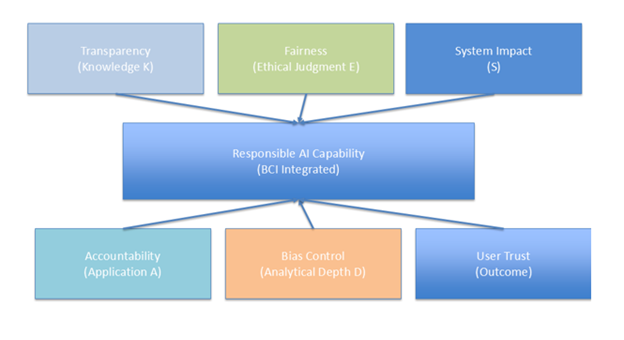
Classical ethical decision-making models (e.g., Rest, Jones) describe decision-making as a progression from awareness to behavior. However, these models do not account for capability measurement, AI influence, or system-level impact—gaps addressed by the BITSPEC Decision Model under Education 6.0.

To address these limitations, BITSPEC introduces the Capability-Based Decision Model under Education 6.0, operationalized through the BITSPEC Capability Index (BCI™).

BCI™ Formula

BCI= (K*A*D*S*E

Where:

  • K — Knowledge (awareness of the issue)
  • A — Application (ability to apply tools and methods)
  • D — Analytical Depth (quality of reasoning and interpretation)
  • S — System Impact (understanding of cross-functional consequences)
  • E — Ethical Judgment (alignment with responsible and sustainable decisions)

BITSPEC Ethical AI Model

Fig. 1- Ethical AI Capability Model

5. Mapping Classical Theory to BCI™
Classical Model
BCI™ Extension

Awareness

    Knowledge (K)

Internal Reasoning

    Analytical Depth (D)

Judgment

    System Impact (S)

Intention

    Ethical Judgment (E)

Behavior

     Capability Output


Key Insight

Classical models describe how decisions are made.
BCI™ measures how well decisions are made.

6. The Role of AI in the Decision Gap

AI introduces a new layer:

✔ Enhances:

  • Data processing
  • Pattern detection
  • Predictive capability

❌ Does NOT guarantee:

  • Correct interpretation
  • Ethical decisions
  • System awareness

AI amplifies the Decision Gap when capability is low.

7. Why Lean Six Sigma Alone Is Not Enough

Lean Six Sigma provides:

  • Statistical rigor
  • Structured problem-solving
  • Analytical tools

Yet failures occur when:

  • The wrong problem is selected
  • Results are misinterpreted
  • Solutions ignore system-wide impact

 Tools support decisions—but do not ensure capability.

8. Real-World Implications

Manufacturing

Local optimization → system bottlenecks

Healthcare

Data-driven protocols → poor patient outcomes

Finance

Algorithmic models → systemic risk

Public Systems

Policy decisions → unintended societal effects

9. Education 6.0: Closing the Decision Gap

Education must shift:

From:

  • Knowledge-based learning
  • Tool-focused training
  • Exam-based certification

To:

  • Capability verification
  • System thinking
  • Ethical reasoning
  • Decision accountability

Education 6.0 Principle

Capability is demonstrated by the quality of decisions and their impact on systems—not by knowledge alone.

10. Conclusion

The modern world does not suffer from a data shortage.

It suffers from a decision capability deficit.

The true competitive advantage is not data.
It is the ability to make correct, ethical, and system-aware decisions.

BITSPEC Positioning Statement

In Education 6.0, capability is not measured by the ability to generate data, but by the ability to make decisions that improve systems.

Article blog written with ChatGPT ver. 5.2 support April 1, 2026


Continue reading
  300 Hits

Day 3 Measurement Crisis in Education and Professional Certification

Day3

Image generated ChatGPT ver. 5.2

Why We Certify Knowledge but Fail to Validate Capability

Abstract

Modern education and professional certification systems continue to rely on assessment models that prioritize knowledge recall over demonstrated capability. While learners are increasingly exposed to complex, dynamic environments—particularly with the rise of artificial intelligence (AI) and digital systems—evaluation frameworks remain rooted in outdated industrial paradigms. This paper argues that the primary failure of education is not a lack of learning, but a failure of measurement. It introduces a capability-based perspective and highlights the need for multidimensional evaluation systems that reflect real-world performance. The BITSPEC Capability Index (BCI™) is presented as a model to address this systemic gap.

1. Introduction: A System That Measures the Wrong Thing

Across education and certification systems, success is typically defined by performance on exams, quizzes, and standardized assessments. Learners are evaluated based on their ability to recall information, apply formulas in controlled environments, and reproduce expected answers.

However, real-world performance rarely depends on recall alone.

Professionals today operate in environments characterized by:

  • uncertainty
  • system complexity
  • interdependent variables
  • ethical decision-making requirements

Despite this reality, most systems continue to certify individuals based on what they know, rather than what they can do.

This misalignment has created what can be described as a measurement crisis.

We do not have a learning crisis. We have a measurement crisis.

2. The Illusion of Competence

Certification is often interpreted as evidence of competence. A completed course, a passing grade, or a professional designation creates the perception that an individual is capable of performing effectively in real-world conditions.

Yet, this assumption is increasingly flawed.

A learner may:

  • pass a statistical exam without being able to interpret real process variation
  • complete Lean Six Sigma training without successfully leading an improvement project
  • obtain certification without understanding system-wide impact or risk

This disconnect stems from a fundamental issue:
assessment systems measure proxies of competence—not competence itself.

Knowledge is treated as a substitute for capability.

3. The Industrial Legacy of Measurement

The current assessment paradigm is not accidental—it is inherited.

Education systems were originally designed to support industrial-era needs:

  • standardization of skills
  • efficiency in training large populations
  • predictable, repeatable outcomes

These systems emphasized:

  • uniform testing
  • fixed answers
  • compliance with predefined standards

While effective for mass education, this model is insufficient for modern environments where:

  • problems are non-linear
  • solutions are context-dependent
  • performance requires judgment, not repetition

The result is a structural mismatch between:

  • what is measured and
  • what actually matters
4. Real-World Consequences of the Measurement Gap

The failure to measure capability has tangible consequences across industries.

4.1 Engineering and Manufacturing

Technicians and engineers are increasingly confronted with highly complex digital systems. When failures occur, resolution requires:

  • system-level thinking
  • root cause analysis beyond surface symptoms
  • integration of multiple knowledge domains

Yet, many professionals lack the depth required to respond effectively—not due to lack of exposure, but due to insufficient evaluation of applied capability.

4.2 Management and Decision-Making

Managers often rely on metrics without understanding:

  • underlying system dynamics
  • unintended consequences of decisions
  • long-term impact on organizational performance

Certification does not guarantee the ability to make informed, system-aware decisions.

4.3 Artificial Intelligence and Ethical Risk

With the integration of AI into decision-making processes, a new dimension has emerged:

  • ethical judgment
  • bias recognition
  • responsible use of automated outputs

Current systems rarely assess whether individuals can:

  • critically evaluate AI-generated results
  • identify ethical risks
  • make accountable decisions

The absence of this dimension creates significant organizational and societal risk.

5. What Is Missing from Measurement

To align evaluation with real-world performance, capability must be understood as multidimensional.

Traditional systems primarily measure:

  • Knowledge (K)

However, real capability requires additional dimensions:

  • Application (A): Ability to use knowledge in real situations
  • Analytical Depth (D): Ability to interpret, question, and analyze
  • System Impact (S): Understanding of broader organizational consequences
  • Ethical Judgment (E): Responsible and informed decision-making

Without these dimensions, assessment remains incomplete.

6. A Capability-Based Perspective: The BCI™ Model

To address this gap, capability can be expressed as an integrated construct:

Capability = Knowledge × Application × Analytical Depth × System Impact × Ethical Judgment

This formulation reflects a critical principle:

Capability is not additive—it is multiplicative.

A deficiency in any one dimension reduces overall capability, regardless of strength in others.

The BITSPEC Capability Index (BCI™) operationalizes this concept by:

  • defining measurable criteria for each dimension
  • requiring evidence-based assessment
  • integrating knowledge and performance into a unified evaluation model

Unlike traditional systems, BCI™ does not assume competence—it requires demonstration.

7. The Role of Artificial Intelligence in Measurement

Artificial intelligence has the potential to transform assessment systems—if used appropriately.

AI can:

  • analyze decision-making patterns
  • evaluate reasoning processes
  • track performance across scenarios
  • identify inconsistencies in applied knowledge

However, AI alone is not a solution.

Without a proper framework, AI risks:

  • reinforcing flawed metrics
  • automating superficial evaluation
  • amplifying existing biases

The effectiveness of AI in education depends on the quality of the measurement model it supports.

8. Toward Education 6.0: Measuring What Matters

The transition toward more advanced educational paradigms requires a shift from:

  • content delivery → capability development
  • knowledge testing → performance validation
  • certification → verification

Education 6.0 represents this shift by emphasizing:

  • real-world application
  • integrated competencies
  • measurable impact

In this model, learning is not complete until capability is demonstrated.

9. Conclusion

The challenges faced in modern education and professional certification are not primarily due to insufficient content or lack of access to knowledge.

They are the result of measuring the wrong outcomes.

As long as systems continue to prioritize knowledge over capability:

  • certification will remain disconnected from performance
  • organizations will face increasing competency gaps
  • individuals will be unprepared for real-world complexity

Until we measure what truly matters, we will continue to certify what does not.

Keywords

Capability Measurement, Education 6.0, Professional Certification, Competence, Artificial Intelligence in Education, Lean Six Sigma, BCI™, Assessment Systems, System Thinking, Ethical Judgment

Article blog written with ChatGPT ver. 5.2 support March 31, 2026

Continue reading
  189 Hits

Day 2 Competence vs Knowledge: Why Modern Systems Fail Despite ‘Trained’ Professionals

Day2

Image generated by ChatGPT version 5.2 (Fast)

Art Perspective + Systems Thinking

There is a silent contradiction shaping modern society:

We have never had more educated people, yet we have never experienced more operational failures in complex systems.

From manufacturing breakdowns to healthcare errors, from aviation incidents to digital system collapses — the pattern is not random.

It is systemic.

It is not a failure of knowledge.
It is a failure of capability.

The Illusion of Competence

Modern education and certification systems are built on a flawed assumption:

If a person knows something, they can perform it.

This assumption no longer holds.

Today’s systems are:

  • Interconnected

  • Dynamic

  • Data-driven

  • AI-influenced

  • High-risk

Yet most professionals are trained through:

  • Static content

  • Standardized exams

  • Memorization-based evaluation

This creates a dangerous illusion:
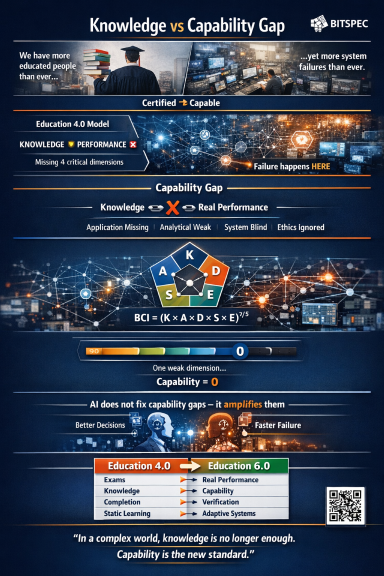
Certified ≠ Capable

Where Systems Actually Fail

Failures do not occur at the level of theory.

They occur at the intersection of:

  • Decision-making under pressure

  • Interpretation of incomplete or conflicting data

  • Ethical judgment

  • System-wide impact awareness

These are not knowledge problems.
These are capability problems.

The Missing Dimensions of Professional Performance

Traditional education measures only one dimension:

  • Knowledge (K)

But real-world performance depends on a multidimensional system:

  • K — Knowledge (What you know)

  • A — Application (What you can do)

  • D — Analytical Depth (How well you think)

  • S — System Impact (Understanding consequences)

  • E — Ethical Judgment (Making responsible decisions)

When any one of these dimensions is weak, system failure becomes likely.

The BCI™ Model (Education 6.0 Foundation)

At BITSPEC, capability is not assumed — it is measured.

The BITSPEC Capability Index (BCI™) defines professional capability as:

Capability = (K × A × D × S × E)^(1/5)

This model reflects a fundamental truth:

Capability is multiplicative, not additive

  • If Ethical Judgment = 0 → Capability collapses

  • If Application is weak → Knowledge becomes irrelevant

  • If System Impact is ignored → decisions create harm

This explains why highly educated systems still fail.

Why AI Makes This Problem Urgent

Artificial Intelligence amplifies both:

  • Human capability

  • Human error

Without strong capability:

  • AI produces misleading outputs

  • Decisions are made without understanding context

  • Risks scale faster than ever before

AI does not replace capability.
It exposes its absence.

The Shift to Education 6.0

We are entering a new phase:

From:

  • Knowledge-based education
    To:

  • Capability-based accreditation

From:

  • Course completion
    To:

  • Verified performance

From:

  • Static learning
    To:

  • Adaptive, system-aware thinking

This is Education 6.0.

Closing Reflection (Art + Philosophy)

A system is only as strong as the decisions made within it.

And decisions are only as good as the capability behind them.

We must stop asking:

“What do people know?”

And start asking:

“What are people capable of doing — responsibly, analytically, and systemically?”

Because in a complex world, knowledge alone is no longer enough.


Article blog written with ChatGPT ver. 5.2 support March 30, 2026


Continue reading
  179 Hits

Day 1 — When Machines Become Abstract Art: The Hidden Language of Modern Manufacturing

Day1

Image generated by ChatGPT version 5.2 (Fast)

Opening Reflection

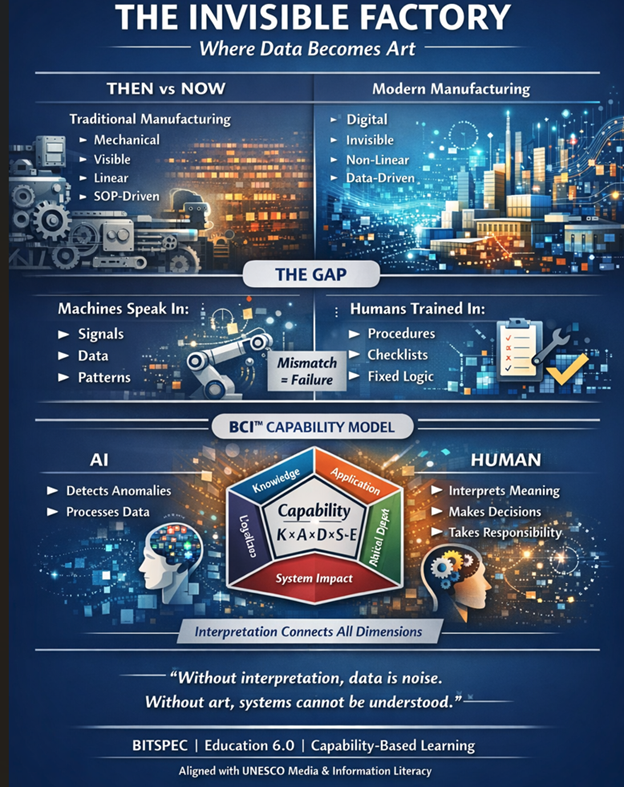
We taught technicians to repair machines they could see. Now machines think, adapt, and communicate in invisible languages—and we never taught anyone how to interpret them.

The Shift

Modern manufacturing is no longer mechanical—it is cyber-physical, algorithmic, and dynamic. Machines now communicate through data streams and operate as interconnected systems.

The Problem

Technicians are trained on procedures, not interpretation. When systems behave unpredictably, organizations rely on escalation rather than understanding.

Complexity as Interpretation

The challenge is not complexity itself—but the inability to interpret it. Modern systems require pattern recognition and contextual understanding.

BCI Perspective

Capability = Knowledge × Application × Analytical Depth × System Impact × Ethical Judgment. Without interpretation, analytical depth, and ethical judgment cannot be achieved.

AI vs Human Gap

AI detects patterns, but humans must interpret meaning and take responsibility. The gap is cognitive, not technological.

Education 6.0

Education must move beyond procedures to interpretation, ethics, and systems thinking.

Closing Reflection

The factory of the future is not just built with machines—it is composed of meaning and interpretation.

Article blog written with ChatGPT ver. 5.2 support

Continue reading
  209 Hits

The complexity gap in any manufacturing environment


Digital technicians

Image generated GPT-5.2 Instant

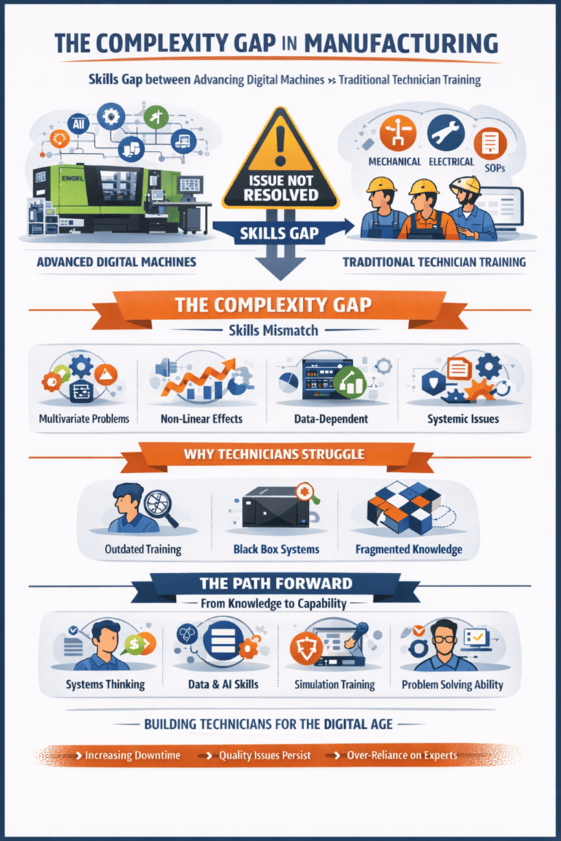
In modern manufacturing environments, the increasing complexity of digital machines has quietly outpaced the evolution of workforce training. What was once a domain of mechanical troubleshooting has transformed into a highly integrated ecosystem of software, sensors, automation logic, data systems, and AI-assisted controls. This shift has created a structural gap: machines are becoming exponentially smarter, while technician training often remains linear, fragmented, and insufficient for the realities on the shop floor.

Take, for example, advanced injection molding systems such as those produced by ENGEL. These machines are no longer just mechanical presses—they are cyber-physical systems. They incorporate real-time process monitoring, closed-loop control systems, predictive maintenance algorithms, and integration with MES/ERP platforms. A single defect in output quality may no longer be traced to a simple mechanical failure, but rather to a complex interaction between temperature gradients, software parameters, sensor calibration, material variability, and even upstream data inputs.

Yet, many technicians are still trained within traditional frameworks:

  • Mechanical troubleshooting
  • Basic electrical diagnostics
  • Standard operating procedures (SOPs)

These competencies, while still necessary, are no longer sufficient.

The Complexity Gap

The issue is not a lack of effort from technicians—it is a mismatch between system complexity and cognitive preparation.

Modern manufacturing problems are:

  • Multivariate (multiple interacting variables)
  • Non-linear (small changes produce disproportionate effects)
  • Data-dependent (requiring interpretation of large datasets)
  • Systemic (root causes span across processes, not isolated components)

However, training programs often:

  • Focus on component-level understanding, not system-level thinking
  • Emphasize compliance (SOPs) rather than diagnostic reasoning
  • Do not integrate data analytics, AI interpretation, or digital literacy
  • Rarely simulate real-world failure complexity

As a result, when a complex issue arises, technicians may:

  • Escalate prematurely
  • Apply trial-and-error fixes
  • Misinterpret symptoms as root causes
  • Depend heavily on OEM support

This is frequently observed with high-end equipment: technicians from OEMs like ENGEL are expected to resolve issues, yet even they may struggle when the problem exceeds predefined diagnostic pathways. The issue is not individual capability—it is the absence of a structured capability framework aligned with modern system complexity.

Why Complexity Is Increasing Faster Than Capability

There are three main drivers:

  1. Digitalization without Educational Transformation
    Industry has rapidly adopted Industry 4.0 technologies, but education systems have not transitioned at the same pace. Training still reflects an “industrial 2.0–3.0 mindset.”
  2. Hidden Knowledge Layers
    Many systems operate as “black boxes.” Technicians interact with interfaces, not underlying logic. Without understanding control algorithms or data models, troubleshooting becomes superficial.
  3. Fragmented Learning Pathways
    Skills are taught in isolation: electrical, mechanical, software—rarely integrated into a unified system perspective.
The Real Risk: Operational Blind Spots

This gap creates significant risks:

  • Increased downtime due to unresolved root causes
  • Quality issues that reoccur despite “fixes”
  • Over-reliance on external experts
  • Inability to leverage machine intelligence (AI features remain unused)

Most importantly, organizations begin operating systems they do not fully understand.

Moving Toward Capability-Based Training

To address this, training must evolve from knowledge-based to capability-based.

A technician in a modern manufacturing environment must develop:

  • Knowledge (K): Understanding of systems, not just components
  • Application (A): Ability to apply tools in real scenarios
  • Analytical Depth (D): Diagnose multivariate problems
  • System Impact (S): Understand upstream/downstream effects
  • Ethical Judgment (E): Use AI and automation responsibly

This aligns with frameworks such as your BCI™ model, where competence is not measured by what someone knows, but by what they can resolve in complex, real-world systems.

The Way Forward

Organizations must rethink technician development:

  • Introduce systems thinking and DOE-based diagnostics
  • Integrate data literacy and AI-assisted analysis
  • Use simulation-based training for complex failure scenarios
  • Shift from SOP adherence to problem-solving capability
  • Build internal expertise instead of relying solely on OEMs
Final Reflection

The challenge is not that machines are too complex. The challenge is that we continue to train people for a simpler world that no longer exists.

Until education and training evolve to match the true nature of digital manufacturing systems, even the most advanced machines will operate below their potential—not because of technical limitations, but because of human capability constraints.

Blog written with the support of OpenAI, ChatGPT (GPT-5.2 Instant), Mar 27, 2026


Continue reading
  239 Hits

When One Mistake Isn’t Just a Mistake: System Failure, Staffing Risk, and BCI™ Perspective


We express our deepest sorrow for the lives lost, and our thoughts are with the families and communities affected by this tragedy. These accidents shall never happen again!!


Bridging the gap

Image generated GPT-5.2 Instant


Introduction

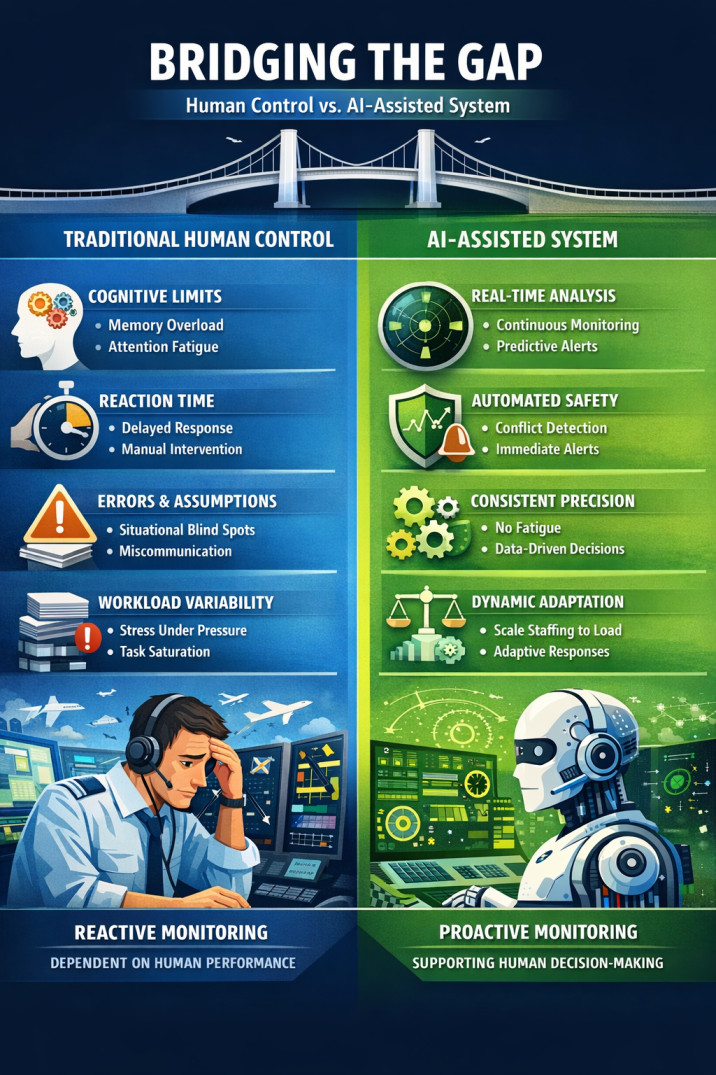
At highly congested airports like LaGuardia, air traffic control represents one of the most complex real-time systems in operation today. When incidents occur, they are often labeled as human errors. However, these events are more accurately understood as system capability failures under load.

Why SOP Allows Only Two Controllers at Night

Standard Operating Procedures (SOPs) are based on expected traffic conditions. During night operations, traffic is assumed to be lower, leading to reduced staffing levels. However, this assumption introduces systemic risk.

Key limitations include:
- Staffing based on average conditions rather than variability
- Role consolidation increases cognitive load
- Reduced human performance due to circadian factors
- Lack of real-time workload adaptation

This creates a gap between procedural design and actual system capability.

BCI™ Capability Interpretation

Capability = Knowledge × Application × Analytical Depth × System Impact × Ethical Judgment

In this scenario:
- Knowledge: High
- Application: Moderate
- Analytical Depth: Reduced under pressure
- System Impact: Critical
- Ethical Judgment: Raises staffing and system design concerns

BCI™ Capability Diagram

          [ K ]= knowledge 
           |
          [ A ]= application
           |
          [ D ]= analytical depth
           |
          [ S ]= system impact
           |
          [ E ]= ethical judgement
           |
     Capability Output

System-Level Recommendations

- Implement dynamic staffing based on real-time traffic complexity
- Integrate AI-assisted monitoring systems
- Enforce role separation under high workload
- Introduce fatigue-aware operational controls

Policy Insight

Staffing in safety-critical systems should not be based solely on expected demand, but on the system’s potential to rapidly increase in complexity.

Blog written with the support of OpenAI, ChatGPT (GPT-5.2 Instant), Mar 25, 2026

Continue reading
  160 Hits

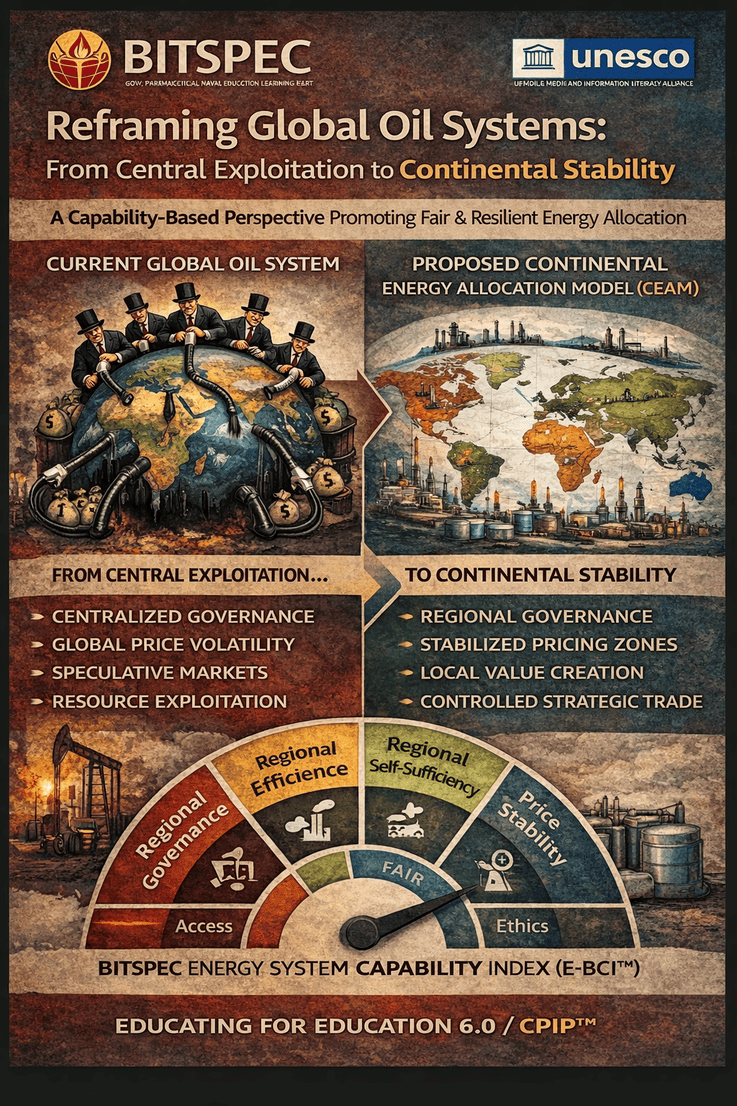
Redesigning Global Oil Systems: From Central Exploitation to Regional Stability

BITSPEC oil solutions


Image generated with AIChatGPT version 5.3

This work extends existing decentralized and regional energy concepts by introducing a capability-based continental allocation model for fossil resources, integrating governance, pricing, and resilience into a unified system design framework.

https://doi.org/10.5281/zenodo.19132342

https://doi.org/10.5281/zenodo.19133393

Continue reading
  197 Hits

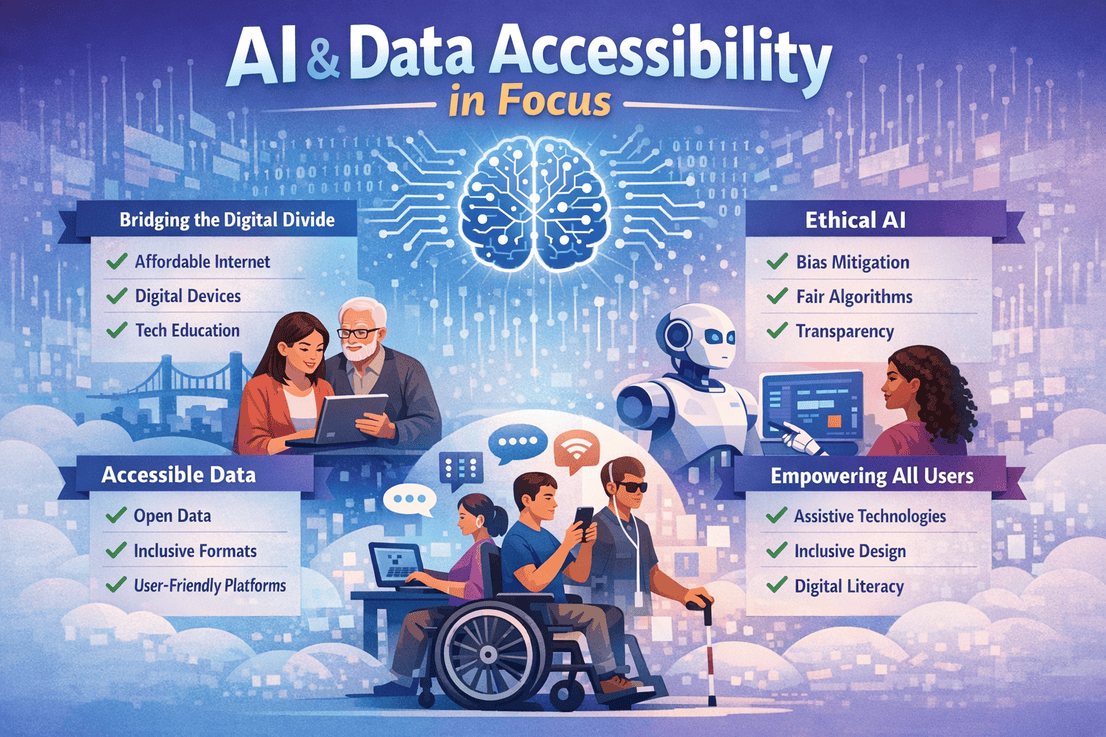
AI and data accessibility


AI and data accessibility


Image AI-generated ChatGPT Instant 5.3

Continue reading
  188 Hits

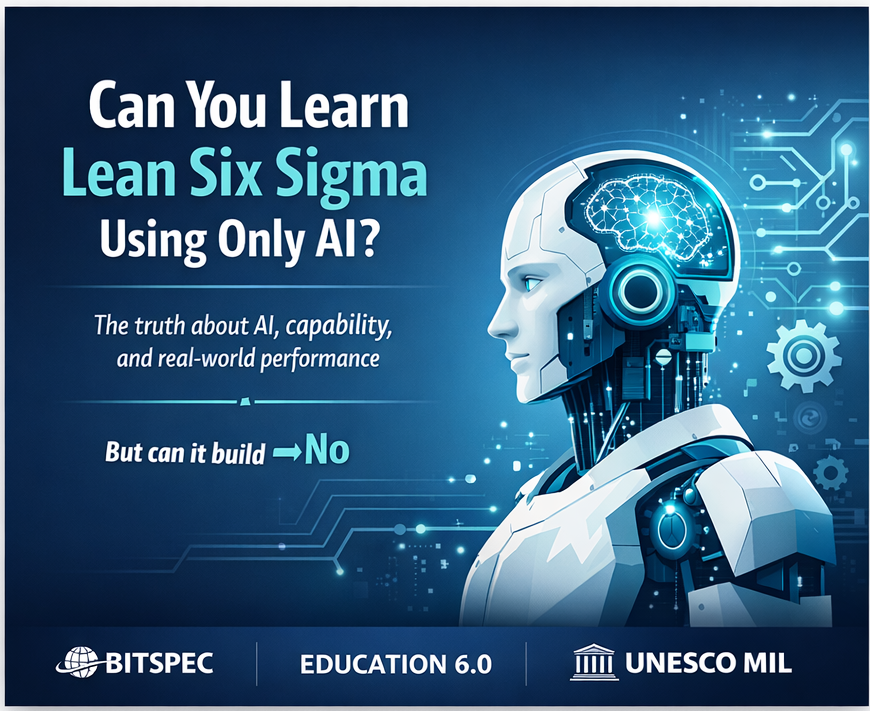
Lean Six Sigma using only AI. Is it possible?

ChatGPT Image Mar 18 2026 10 57 04 AM


Why can't we build or learn solely on AI?


Continue reading
  158 Hits

What Happened to Lean Six Sigma Certification?

Lean Six Sigma has been one of the most influential methodologies in modern operational management. Since its origins in manufacturing, it has helped organizations across industries improve quality, reduce waste, and make better decisions using data and statistical analysis.

However, over the past two decades the Lean Six Sigma certification landscape has become increasingly fragmented. Many professionals today ask a simple question:

Which Lean Six Sigma certification actually represents real capability?

Understanding this situation requires looking at how Lean Six Sigma certification evolved over time.

The Corporate Origins of Lean Six Sigma

Lean Six Sigma originated inside large corporations during the late twentieth century. Companies such as Motorola and General Electric developed internal improvement programs designed to train employees in statistical thinking, process optimization, and data-driven decision making.

In these early implementations, certification was not managed by external organizations. Instead, employees demonstrated their competence through successful improvement projects. Recognition as a Green Belt or Black Belt was typically granted after measurable operational results were achieved.

In other words, certification reflected demonstrated capability rather than examination performance.

The Expansion of the Training Market

During the early 2000s Lean Six Sigma gained global popularity. As organizations across industries began adopting the methodology, demand for training increased rapidly.

Professional organizations and training providers began offering certification programs. Some of the most recognized organizations involved in this expansion included:

  • American Society for Quality

  • International Association for Six Sigma Certification

While these organizations helped promote the methodology and develop bodies of knowledge, each provider established its own certification structure, examination process, and evaluation standards.

Unlike professions such as accounting or medicine, Lean Six Sigma did not develop a single global certification authority.

The Rise of Commercial Certification

In the following decade the certification market expanded further as additional organizations entered the field. Certification programs increasingly relied on standardized examinations and accreditation networks for training providers.

Some organizations began operating primarily as certification platforms, licensing training partners and selling certification examinations. An example of this model is PeopleCert.

While such systems made certification widely accessible, they also shifted the emphasis toward brand recognition and examination performance, sometimes with limited verification of real-world capability.

Why the Certification Landscape Became Fragmented

Several factors contributed to the current fragmentation of Lean Six Sigma certification.

First, the methodology originated as a corporate improvement system rather than a regulated profession. As a result, there was no central governing body responsible for establishing universal certification standards.

Second, certification providers developed independent bodies of knowledge and evaluation models, resulting in multiple competing certification paths.

Third, most certification systems operate outside the framework of international certification standards such as ISO/IEC 17024, which defines requirements for organizations certifying professional competence.

Without a unified certification framework, the market evolved into a diverse ecosystem of training organizations, professional societies, and commercial certification providers.

The Growing Importance of Demonstrated Capability

As organizations become increasingly data-driven, employers are placing greater emphasis on demonstrated analytical capability and measurable improvement outcomes.

Professionals are expected not only to understand Lean Six Sigma tools but also to apply them effectively to complex operational systems.

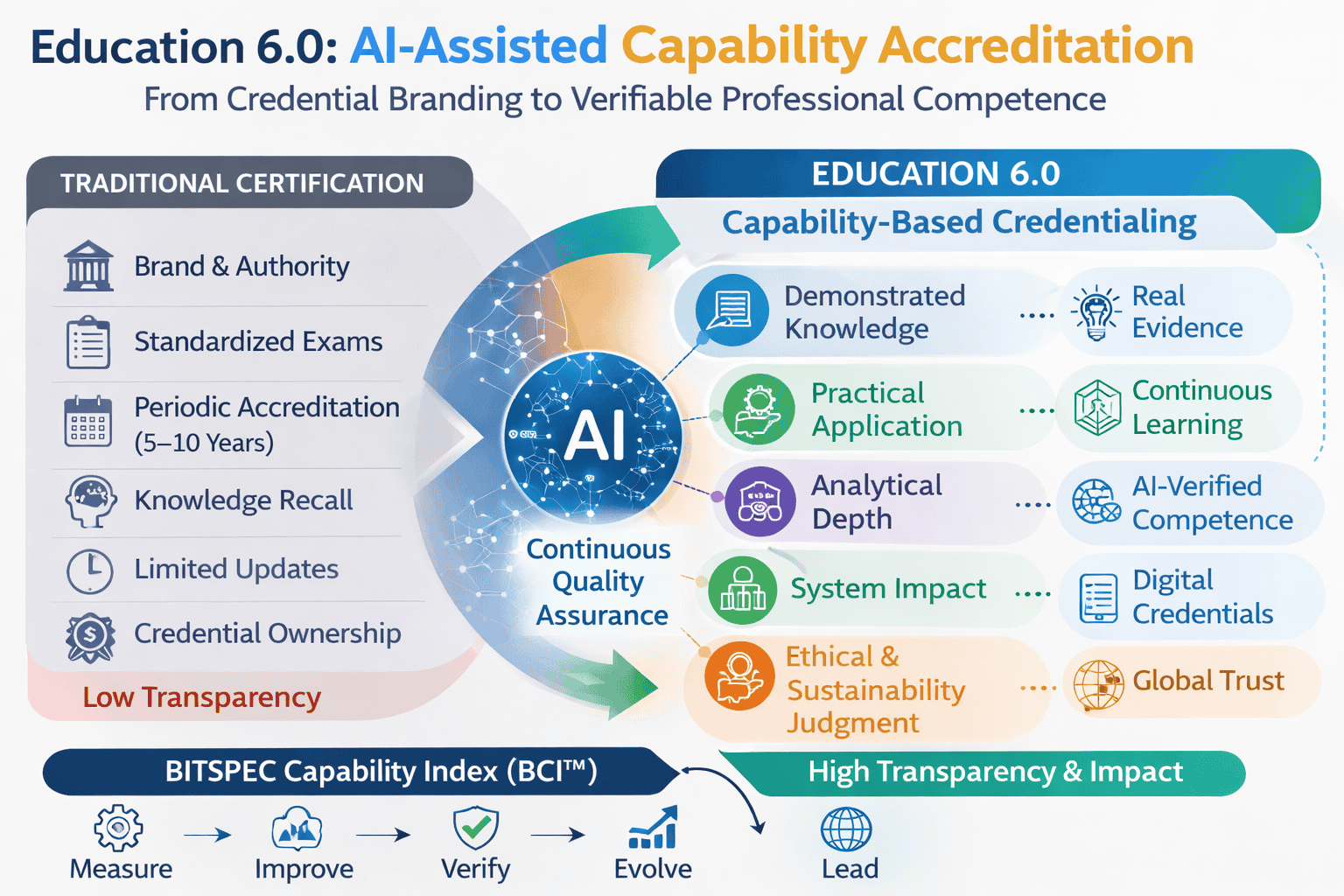
This shift is contributing to the emergence of capability-based credentialing models, where certification reflects:

  • analytical competence

  • practical application of improvement methodologies

  • measurable system impact

  • responsible and ethical decision making.

Education 6.0 and the Future of Professional Credentialing

Advances in digital learning technologies and artificial intelligence are enabling new approaches to evaluating professional capability.

Education 6.0 represents a model of professional education that emphasizes:

  • competency-based learning

  • evidence-supported credentialing

  • AI-assisted quality assurance

  • continuous verification of professional capability.

In this framework, credentials are supported not only by examination results but also by documented evidence of applied analytical work and operational improvements.

Moving Toward Transparent Certification Systems

The evolution of Lean Six Sigma certification highlights the importance of transparency and governance in professional credentialing.

Modern certification systems increasingly require:

  • clearly defined competency frameworks

  • documented certification processes

  • impartial certification decisions

  • independent governance oversight.

International standards such as ISO/IEC 17024 provide guidance for organizations responsible for certifying professional competence.

A New Opportunity for Professional Education

Lean Six Sigma remains one of the most valuable methodologies for improving organizational performance. However, the certification ecosystem is continuing to evolve as industries demand greater transparency and stronger evidence of professional capability.

By combining competency frameworks, digital learning systems, and AI-assisted evaluation methods, new education models can help ensure that professional credentials reflect real capability and measurable impact.

The future of Lean Six Sigma certification may therefore move toward systems that emphasize evidence, transparency, and capability verification, aligning professional education more closely with the needs of modern organizations.


Editor’s Note – Understanding the Certification Ecosystem

Many certification ecosystems operate through networks of Authorized Training Organizations (ATOs). In this model, the certification body manages the credential framework and examination system, while training organizations deliver courses and recruit candidates. Certification bodies often promote the credential brand globally but do not market individual training providers. As a result, training organizations typically invest their own resources in marketing and student acquisition. This structure reflects the broader economics of the professional certification marketplace.

Dorina Grossu is the co-founder of BITSPEC and a member of the UNESCO Media and Information Literacy Alliance. Her work focuses on capability-based education, AI-assisted learning systems, and professional competency development.

Blog written with the support of OpenAI, ChatGPT (GPT-5.2 Instant), Mar 16, 2026

Continue reading
  228 Hits

From Certification Branding to Capability Verification


Why Education 6.0 Is Changing Professional Credentials?

Competency

Education 6.0 AI-Assisted Capability Accreditation Model.
Source: BITSPEC (2026). Generated with AI assistance.


Professional certification has played an important role in the development of modern industries. Over the past decades, certification bodies have helped establish global standards that have allowed professionals to demonstrate their expertise and enabled organizations to identify qualified specialists.

Organizations such as the American Society for Quality, Project Management Institute, and PeopleCert created certification frameworks that helped structure bodies of knowledge across many professional domains.

However, the nature of professional work has changed significantly. Today’s organizations operate in environments shaped by data analytics, artificial intelligence, digital transformation, and complex systems thinking. As a result, the way professional competence is evaluated is also evolving.

Increasingly, employers are asking a different question:

What can a professional actually do in real operational environments?

This shift is leading to a new paradigm in professional education and credentialing.

The Limits of Traditional Certification

Traditional certification systems typically rely on:

• standardized examinations
• institutional authority
• periodic accreditation reviews.

While these mechanisms remain valuable, they do not always capture whether a professional can effectively apply knowledge in practice.

In many industries, professionals may successfully pass examinations while still lacking the ability to:

• analyze real operational data
• design improvement experiments
• implement sustainable process changes
• evaluate complex systems interactions.

As industries become more data-driven and interdisciplinary, certification systems must evolve to ensure that credentials reflect true professional capability.

The Emergence of Education 6.0

Education systems have evolved alongside technological and societal changes.

Earlier education models focused primarily on:

• knowledge transmission
• standardized instruction
• institutional authority.

Education 6.0 represents a new stage in this evolution, emphasizing:

• capability development
• evidence-based learning outcomes
• continuous competency verification
• integration of artificial intelligence in learning systems.

In this paradigm, professional credentials are based not only on examination results but also on demonstrated ability to apply knowledge in real-world environments.

AI-Assisted Capability Accreditation

Artificial intelligence is increasingly becoming a powerful tool for supporting educational quality assurance.

Rather than replacing educators, AI systems assist in analyzing evidence of learning and professional capability.

AI-supported evaluation can help verify:

• alignment between curriculum and competency frameworks
• consistency and validity of assessment methods
• patterns in learner performance across cohorts
• authenticity and integrity of assessment submissions.

These capabilities allow education systems to move from periodic accreditation reviews toward continuous evidence-based quality assurance.

The BITSPEC Capability Index (BCI™)

At BITSPEC, professional certification is structured around the BITSPEC Capability Index (BCI™), which evaluates professional competence across five interconnected dimensions.

CapabilityDescription
Knowledge theoretical understanding of principles and frameworks
Application ability to apply methods to real operational problems
Analytical Depth use of statistical reasoning and data analysis
System Impact measurable improvements in processes or systems
Ethical and Sustainability Judgment responsible decision-making considering long-term societal and environmental impact


Through assignments, analytical exercises, and real-world improvement projects, BCI evaluates the depth and effectiveness of professional capability.

Governance and Certification Integrity

As professional credentialing evolves, transparency and governance remain essential.

BITSPEC certification programs operate under a documented governance framework that ensures:

• impartial certification decisions
• competency-based evaluation standards
• transparent certification procedures
• oversight through a Certification Governance Advisory Board.

These governance principles align with the international certification framework described in ISO/IEC 17024, which defines requirements for certification bodies responsible for professional credentialing.

Toward Evidence-Based Professional Credentials

The future of professional credentialing is likely to be characterized by:

• competency-based certification models
• digital credentials supported by evidence
• project and portfolio-based evaluation
• AI-assisted quality monitoring.

In this environment, the value of a credential will increasingly depend on the evidence supporting the capability behind it, rather than on institutional branding alone.

Education 6.0 reflects this transformation by focusing on the development and verification of professional capability in complex, data-driven environments.

The Role of Responsible Technology

As artificial intelligence becomes more integrated into learning systems, professionals must also develop the ability to critically evaluate digital information and technology systems.

As a member of the UNESCO Media and Information Literacy Alliance, BITSPEC integrates principles of media and information literacy within its education framework.

Professionals must be able to:

• critically assess information sources
• understand the capabilities and limitations of AI systems
• apply ethical reasoning in technology-supported decision-making
• promote responsible and sustainable innovation.

A New Direction for Professional Education

The evolution from traditional certification models toward capability-based credentialing reflects broader changes in how knowledge and professional competence are understood.

Education 6.0 represents an opportunity to create credentialing systems that are:

• transparent
• evidence-based
• aligned with real professional practice
• supported by modern analytical technologies.

By combining competency frameworks, AI-assisted evaluation, and transparent governance, BITSPEC contributes to the development of a professional education ecosystem in which credentials represent verified capability and measurable impact.

Blog written with the support of OpenAI, ChatGPT (GPT-5.2 Instant), Mar 16, 2026


Continue reading
  272 Hits

Why Some Countries Treat School Principals as “Master Teachers” While Others Treat Them as Managers


Education_6.jpeg

Education systems around the world organize school leadership in very different ways.
In some countries, principals are considered senior educators within the teaching profession, while in others they function primarily as administrative managers of institutions.

This distinction may seem small, but it significantly influences school culture, teacher development, and educational outcomes.

Understanding these models helps explain how leadership structure affects the quality, stability, and long-term performance of education systems.

Two Dominant Models of School Leadership

Globally, two major models of school leadership exist.
1. The Master-Teacher Leadership Model

Countries such as Greece, Finland, and Japan follow a model where principals are first and foremost experienced teachers.

School leaders remain part of the educational profession, and leadership is considered an extension of teaching expertise.

Key characteristics:

  • Principals are selected from experienced teachers

  • They often continue teaching or mentoring

  • Leadership is considered a temporary professional duty

  • Principals may return to teaching roles later

  • Authority is based on pedagogical expertise

This model emphasizes that schools are learning communities, not simply organizations to be managed.

2. The Administrative Manager Model

In countries such as Canada, the United States, and parts of the UK, school principals function primarily as institutional managers.

They often transition into a separate career track that focuses heavily on:

  • budgeting

  • compliance

  • reporting

  • operations management

  • staffing administration

Key characteristics:

  • principals often stop teaching entirely

  • leadership becomes a separate administrative profession

  • emphasis on management training rather than teaching mastery

  • long-term career progression in school administration

This model treats schools more like complex organizations requiring operational management.

Why the Master-Teacher Model Developed

Many European and Asian education systems were historically designed around the idea of an educational corps, similar to professional guilds.

Teachers belonged to a professional body, and leadership roles emerged from within that body.

This philosophy assumes:

  • educational leadership should come from deep instructional expertise

  • teachers respect leaders who understand classroom realities

  • school improvement depends on pedagogical guidance rather than managerial control

Finland and Japan are often cited as strong examples of this approach.

Advantages of the Master-Teacher Model

Several benefits are associated with this leadership structure.

Strong instructional leadership

Principals can guide curriculum, assessment, and pedagogy because they fully understand the teaching process.

Higher teacher trust

Teachers are more likely to trust leaders who have demonstrated excellence in teaching.

Professional culture

Schools function more like collaborative learning environments than hierarchical bureaucracies.

Long-term educational focus

Decisions tend to prioritize student learning and instructional quality rather than short-term administrative metrics.

Advantages of the Administrative Model

The administrative model also offers important strengths.

Strong organizational management

Schools are complex institutions requiring expertise in:

  • finance

  • infrastructure

  • legal compliance

  • personnel management

Strategic planning

Administrative leaders often receive specialized training in:

  • leadership

  • policy implementation

  • institutional governance

Scalability

This model can support large school systems where administrative complexity is high.

The Hidden Risk in Both Models

Both systems also have weaknesses.

Risk in the Master-Teacher Model

Principals may receive limited management training, making it harder to manage budgets, staffing conflicts, or policy requirements.

Risk in the Administrative Model

Principals may become detached from classroom realities, which can lead to:

  • policies that do not work in practice

  • teacher disengagement

  • loss of instructional focus

Toward a New Model of Educational Leadership

Modern education systems increasingly require leaders who combine both capabilities:

  1. Deep pedagogical expertise

  2. Strong systems leadership and management

In other words, the future of education leadership may require hybrid professionals who understand both learning systems and organizational systems.

This aligns with emerging models such as capability-based education frameworks, where leadership competence includes:

  • instructional leadership

  • analytical decision-making

  • system performance management

  • ethical and sustainability judgment

Education Leadership in the Era of Capability-Based Learning

As education evolves toward Education 6.0, leadership must also evolve.

Schools increasingly operate within complex ecosystems involving:

  • digital learning platforms

  • AI-assisted instruction

  • interdisciplinary collaboration

  • competency-based assessment

  • global knowledge networks

In this environment, the most effective school leaders will be those who can integrate:

  • educational expertise

  • data-driven decision making

  • systems thinking

  • ethical governance

Leadership, therefore, becomes less about authority and more about the capability to guide complex learning systems.

Final Reflection

The question is no longer whether principals should be teachers or managers.

The real challenge is preparing leaders who can function as educational system architects—professionals capable of improving learning, supporting teachers, and managing complex institutions simultaneously.

Education systems that succeed in developing such leaders will likely be better positioned to meet the demands of the rapidly changing knowledge economy.

Dorina Grossu is the co-founder of BITSPEC and a member of the UNESCO Media and Information Literacy Alliance. Her work focuses on capability-based education, AI-assisted learning systems, and professional competency development.

Blog written with the support of OpenAI, ChatGPT (GPT-5.2 Instant), Mar 15, 2026

Continue reading
  182 Hits

The Future of Lean Six Sigma: From Process Improvement to System Performance


For more than four decades, Lean Six Sigma has helped organizations reduce defects, eliminate waste, and improve operational efficiency. From manufacturing floors to healthcare systems, the methodology has delivered measurable value by focusing on variation reduction and structured problem-solving.

However, the world in which organizations operate is changing rapidly.

Digital transformation, artificial intelligence, sustainability requirements, and increasingly complex organizational systems are reshaping how performance improvement must be approached. As a result, Lean Six Sigma is entering a new phase of evolution.

From Process Improvement to System Performance

Traditional Lean Six Sigma programs have focused primarily on improving individual processes. Teams analyze variation, identify root causes, and implement solutions that optimize specific operations.

In the emerging environment, organizations must think beyond isolated processes and instead focus on whole-system performance.

Modern challenges involve interconnected systems:

• global supply chains
• healthcare delivery networks
• digital platforms
• energy and resource systems
• public policy and governance frameworks

Improving one process is no longer sufficient if the surrounding system remains inefficient or unstable. The future of improvement, therefore, requires stronger systems thinking and system architecture capabilities.

The Role of Data and Artificial Intelligence

Another major shift is the integration of advanced analytics and artificial intelligence.

Historically, Lean Six Sigma practitioners relied on statistical tools such as regression analysis, control charts, and design of experiments. These tools remain essential, but they are increasingly complemented by:

• machine learning models
• predictive analytics
• digital twins
• real-time process monitoring

AI can now detect patterns, anomalies, and correlations within massive datasets that would be difficult for humans to analyze manually.

This does not replace the practitioner. Instead, it elevates the role of the professional toward interpretation, strategic decision-making, and system design.

Sustainability as a Core Performance Metric

Environmental sustainability is becoming a central dimension of operational excellence.

Future improvement initiatives must consider not only cost, quality, and delivery, but also:

• energy consumption
• carbon emissions
• material lifecycle impact
• resource efficiency

Lean thinking has always emphasized waste reduction. Today, that concept expands to include environmental waste and long-term sustainability.

Organizations that integrate operational excellence with sustainability will be better positioned for the challenges of the coming decades.

Beyond Toolkits: Developing Professional Capability

Another important evolution concerns how professionals are trained and evaluated.

Traditional certification models often emphasize passing exams that test knowledge of tools and terminology. While theoretical knowledge remains important, organizations increasingly need professionals who can demonstrate capability in real systems.

This includes the ability to:

• analyze complex operational environments
• interpret large datasets
• design sustainable improvement strategies
• lead multidisciplinary teams
• make ethically informed decisions

Professional education must therefore move toward capability-based learning and evidence-based assessment.

A New Generation of Improvement Professionals

The improvement professionals of the future will operate at the intersection of several disciplines:

• operations and quality engineering
• data analytics and statistical modeling
• sustainability management
• organizational leadership
• governance and policy awareness

Their work will extend beyond improving individual processes to designing resilient, efficient, and sustainable systems.

The Opportunity Ahead

Lean Six Sigma remains one of the most powerful frameworks for structured problem-solving. Its core principles—data-driven decision-making, systematic analysis, and continuous improvement—remain highly relevant.

However, the next generation of professional development must expand these principles to address the realities of modern organizations.

At BITSPEC, our programs increasingly focus on developing professionals who can analyze and improve complex socio-technical systems, combining operational excellence with advanced analytics, sustainability thinking, and ethical decision-making.

The future of improvement is not only about efficiency.

It is about building capable professionals who can design better systems for organizations, communities, and society.

#OperationalExcellence #LeanSixSigma #SystemsThinking #QualityEngineering #ProfessionalEducation #BITSPEC

Blog written with the support of OpenAI, ChatGPT (GPT-5.2 Instant), Mar 11, 2026

Continue reading
  217 Hits
Cron Job Starts