
Bitspec
The Future of Professional Certification Article 1
Why Professional Certification Matters
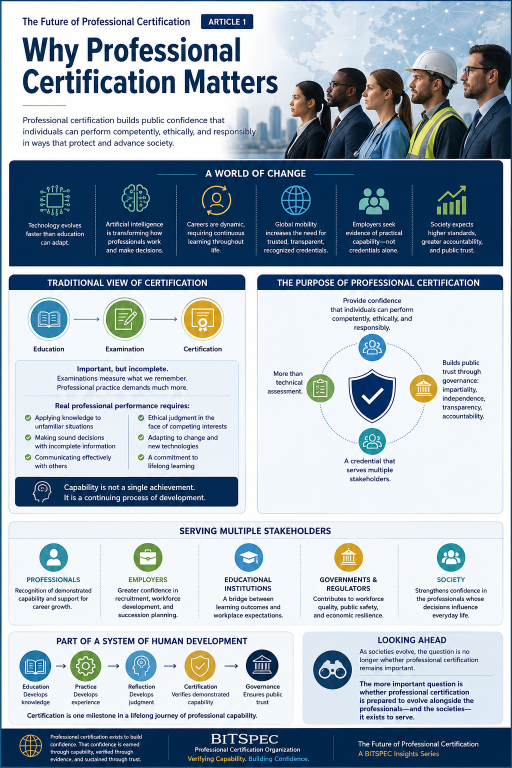
For centuries, societies have depended upon professionals to perform work that directly affects people's lives.
Engineers design the infrastructure that supports communities. Healthcare professionals care for patients whose lives depend upon sound clinical judgment. Financial professionals safeguard investments and economic stability. Information technology specialists protect critical systems upon which governments, businesses, and citizens increasingly rely.
In each profession, the public places trust in individuals whose knowledge, judgment, and decisions have real-world consequences.
That trust is not automatic.
It must be earned.
Professional certification emerged as one of society's mechanisms for building confidence that individuals possess the competence necessary to perform their responsibilities responsibly and ethically.
Yet the world in which professional certification developed has changed dramatically.
Technology evolves faster than educational programs can adapt.
Artificial intelligence is transforming how professionals work and make decisions.
Careers are becoming increasingly dynamic, requiring continuous learning rather than a single period of education followed by decades of practice.
Global mobility enables professionals to work across borders, creating greater demand for credentials that are recognized, trusted, and transparent.
Employers increasingly seek evidence of practical capability rather than academic qualifications alone.
These changes raise an important question:
Is professional certification evolving quickly enough to meet the needs of modern society?
Traditionally, certification has often been associated with completing a training course, passing an examination, and receiving a credential.
While these elements remain important, they do not always provide a complete picture of professional capability.
Knowledge is essential.
Memory is valuable.
Examinations serve an important purpose.
However, professionals rarely succeed solely because they can recall information during a timed assessment.
Real professional performance requires much more.
It requires applying knowledge to unfamiliar situations.
It requires making sound decisions when information is incomplete.
It requires communicating effectively with others.
It requires ethical judgment when facing competing interests.
It requires adapting to changing technologies and evolving workplace expectations.
Most importantly, it requires continuing to learn long after formal education has ended.
Professional capability is therefore not a single achievement.
It is a continuing process of development.
This distinction becomes increasingly important as artificial intelligence assumes greater responsibility for retrieving information, performing calculations, generating recommendations, and automating routine tasks.
As access to information becomes easier, the value of professionals increasingly lies not in what they can memorize, but in how they interpret information, exercise judgment, evaluate evidence, collaborate with others, and act responsibly.
Certification systems must evolve accordingly.
The purpose of professional certification should not simply be to recognize that an individual once completed a course or successfully answered examination questions.
Its broader purpose is to provide confidence that an individual can perform competently, ethically, and responsibly within the context of professional practice.
Achieving this objective requires more than technical assessment.
It requires governance.
Certification systems must operate with impartiality, independence, transparency, accountability, and clearly defined responsibilities. Public confidence depends not only upon how candidates are assessed, but also upon the credibility of the organizations responsible for making certification decisions.
When governance is strong, certification becomes more than a credential.
It becomes an instrument of public trust.
Professional certification also serves multiple stakeholders simultaneously.
For professionals, it provides recognition of demonstrated capability and supports career development.
For employers, it offers greater confidence during recruitment, workforce development, and succession planning.
For educational institutions, it creates a bridge between learning outcomes and workplace expectations.
For governments and regulators, it contributes to workforce quality, public safety, and economic resilience.
For society, it helps strengthen confidence in the professionals whose decisions influence everyday life.
Viewed from this perspective, professional certification is not merely an administrative process.
It is part of a broader system of human development.
Education develops knowledge.
Practice develops experience.
Reflection develops judgment.
Professional certification should verify that these elements have been integrated into demonstrated capability.
Governance ensures that this verification can be trusted.
This series explores how professional certification can continue evolving in response to changing technologies, workforce expectations, lifelong learning, artificial intelligence, and the growing importance of public trust.
Rather than viewing certification as the final destination of education, we invite readers to consider a different perspective.
Certification is not the end of learning.
It is one milestone in a lifelong journey of professional capability.
As societies continue to evolve, the question is no longer whether professional certification remains important.
The more important question is whether professional certification is prepared to evolve alongside the professionals—and the societies—it exists to serve.
The Future of Professional Certification
A BITSPEC Insights Series
BITSPEC
Professional Certification Organization
Verifying Capability. Building Confidence.
Article blog written with ChatGPT Instant 5.5 support, June 25, 2026
When you subscribe to the blog, we will send you an e-mail when there are new updates on the site so you wouldn't miss them.
