
Bitspec
Capability Without Governance: When Great Leaders Become Great Controllers
Introduction
Societies often assume that education produces better leaders.
Universities, governments, corporations, and professional organizations invest enormous resources in developing future decision-makers. The underlying assumption is simple: more knowledge leads to better outcomes.
History tells a more complicated story.
Some of the most transformative leaders were highly educated.
Some of the most controlling leaders were highly educated as well.
The difference was not in capability.
The difference was governance.
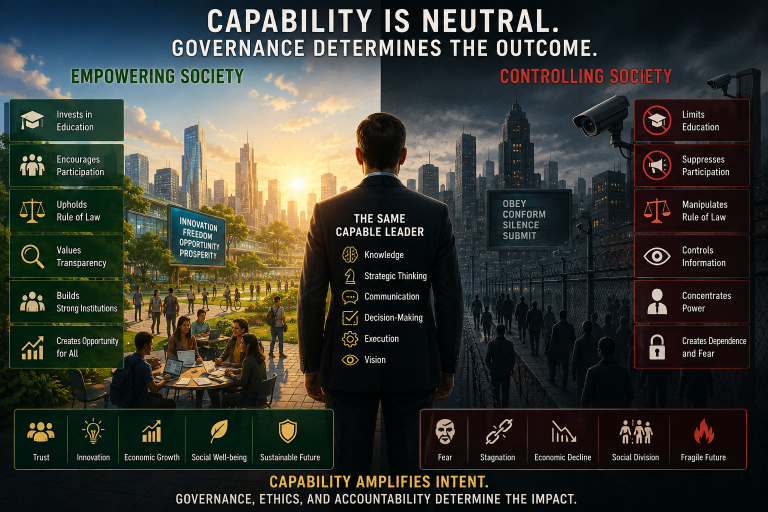
Capability is a force multiplier. It amplifies the intentions of those who possess it. Without governance, accountability, ethics, and transparency, capability can become a mechanism for control rather than development.
The question is therefore not whether leaders are capable.
The question is whether institutions ensure that capability serves society rather than the preservation of power.
The Misunderstanding About Leadership
Many people assume that poor governance is caused by ignorance.
In reality, ineffective governance is often created by highly capable individuals who understand systems exceptionally well.
They understand:
- economics,
- organizational behavior,
- human psychology,
- communication,
- technology,
- political structures,
- institutional incentives.
Such individuals often possess the knowledge necessary to improve society.
They also possess the knowledge necessary to preserve their own authority.
The difference lies in the governance framework surrounding them.
A highly capable leader without accountability can become exceptionally effective at maintaining control.
How Intelligent Systems Preserve Power
The popular image of corruption is often simplistic.
People imagine incompetence, chaos, and obvious abuse.
Reality is frequently more sophisticated.
The most durable systems are often managed by highly intelligent individuals who understand exactly how institutions function.
They understand:
- who receives opportunities,
- who receives recognition,
- who receives resources,
- who gains influence,
- who remains excluded.
As a result, control is rarely maintained through force alone.
Control is maintained through systems.
The most effective systems of control are often those that appear fair on the surface while quietly directing outcomes beneath the surface.
The Shift from Capability to Recognition
One of the most effective mechanisms of institutional control occurs when recognition becomes more important than capability.
In a healthy system, capability generates opportunity.
In a controlled system, recognition generates opportunity.
This distinction appears small but has enormous consequences.
Capability asks:
"What can this person do?"
Recognition asks:
"Has an approved institution already accepted this person?"
Once recognition becomes the primary gateway, institutions gain enormous power over who succeeds and who remains invisible.
Process Control as a Tool of Power
Most people focus on outcomes.
Governance focuses on processes.
This is why highly capable leaders understand that controlling processes is often more effective than controlling people.
If an institution controls:
- admissions,
- licensing,
- accreditation,
- credential recognition,
- promotion pathways,
- hiring standards,
It can shape outcomes without directly interfering with individuals.
The system itself performs the filtering.
This is far more powerful than direct intervention because the process appears objective even when the underlying assumptions may never be examined.
The Capability Suppression Problem
A society may publicly claim to reward merit, competence, education, and innovation.
However, capability cannot be observed if individuals are never allowed to enter the environments where capability becomes visible.
An engineer demonstrates capability by engineering.
A physician demonstrates capability by practicing medicine.
A professor demonstrates capability by teaching.
A researcher demonstrates capability by conducting research.
When admission to these environments becomes restricted through institutional mechanisms, capability may never become observable.
The individual is not evaluated on performance.
The individual is evaluated on eligibility.
This distinction is one of the most overlooked governance failures in modern societies.
Why Intelligent Leaders Prefer Process-Based Control
Highly capable leaders understand something that most citizens do not.
Direct suppression creates resistance.
Process-based suppression creates compliance.
People rarely question a decision when it is presented as:
- policy,
- procedure,
- regulation,
- accreditation,
- qualification requirements,
- administrative review.
Yet these mechanisms determine who receives opportunity and who does not.
The greatest concentration of power therefore, exists not in the final decision but in the design of the process itself.
Those who design the process often determine the outcome long before the outcome becomes visible.
Education 6.0 and Governance
Education 6.0 introduces a critical question:
Are institutions developing capability, or are they managing recognition?
Traditional systems focus heavily on credentials.
Capability-based systems focus on demonstrated competence.
The distinction is fundamental.
A credential is an outcome.
Capability is a demonstrated reality.
The future of governance depends upon the ability to distinguish between the two.
The BITSPEC Perspective
The BITSPEC Capability Index (BCI™) is built upon a simple principle:
Capability must be verified through trustworthy processes.
The purpose of governance is not merely to ensure compliance.
The purpose of governance is to ensure that capability can emerge, be observed, and be recognized fairly.
When governance fails, institutions stop identifying talent.
Instead, they begin protecting existing structures.
The result is capability suppression.
Not because capable people do not exist.
But because the system never allows their capability to become visible.
Conclusion
The greatest threat to society is not an incapable leader.
An incapable leader creates visible failure.
A highly capable leader operating within weak governance structures can create something far more dangerous:
A system that appears fair while quietly preserving power.
The most sophisticated forms of control are not based on force.
They are based on process design.
They determine who receives opportunity, who receives recognition, and who is permitted to demonstrate capability.
The future of governance, therefore, depends on a principle that is often forgotten:
Capability should create recognition.
Recognition should not determine capability.
Once that relationship is reversed, institutions stop serving society and begin serving themselves.
That is when great leaders become great controllers.
Article blog written with ChatGPT Instant 5.5 support, June 24, 2026
When you subscribe to the blog, we will send you an e-mail when there are new updates on the site so you wouldn't miss them.
