
Bitspec
Learning Is Not Equal: What Magnesium, Neuroscience, and Human Diversity Reveal About Education
For generations, educational systems have been designed around a powerful but largely unexamined assumption:
If learners receive the same instruction, they should achieve similar outcomes.
When differences in performance emerge, explanations are often sought in motivation, effort, socioeconomic status, teaching quality, or access to resources.
While these factors certainly influence learning, modern neuroscience increasingly suggests that another reality must be considered:
Human beings do not begin learning from identical biological conditions.
The brain is a biological system. Learning is therefore not merely an educational process; it is also a neurological and physiological process.
Recent advances in neuroscience have begun to reveal how even fundamental biological factors can influence the mechanisms underlying memory formation, learning, and cognitive performance.
One example is magnesium.
Magnesium and the Biology of Learning
For decades, magnesium was primarily associated with bone health, muscle function, and cardiovascular regulation.
Research now suggests its role is far more significant within the brain.
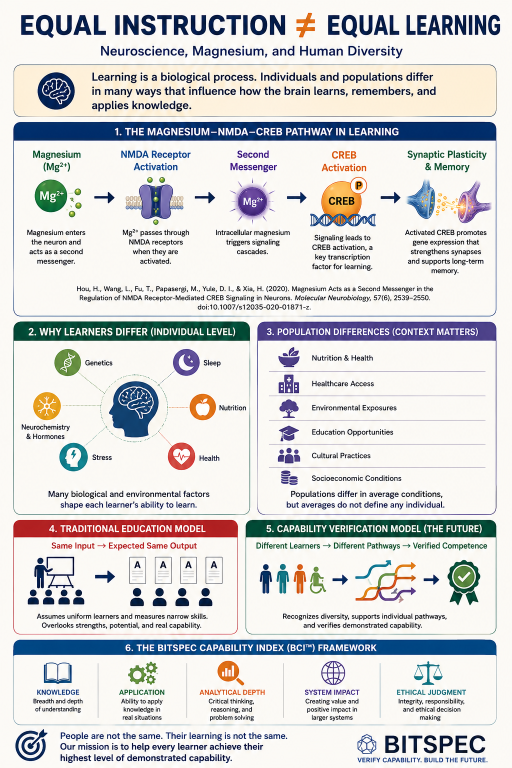
In a landmark study published in Molecular Neurobiology, Hou et al. (2020) demonstrated that magnesium can act as a second messenger in neurons, participating directly in signaling pathways involved in learning and memory. The researchers found that magnesium influx through NMDA receptor pathways contributes to CREB activation, a critical process associated with synaptic plasticity and long-term memory formation.
CREB (cAMP Response Element-Binding Protein) is widely recognized as one of the key molecular regulators involved in converting short-term experiences into long-term memories.
The study's findings suggest that magnesium is not simply a passive mineral present in the nervous system. Rather, it may actively participate in the biological signaling processes that allow neurons to adapt, learn, and store information.
The Implication for Education
This research does not imply that magnesium alone determines intelligence or educational success.
However, it highlights an important reality:
Learning depends upon biological mechanisms that vary between individuals.
Students do not arrive in classrooms with identical neurological conditions.
Differences may exist in:
- Nutritional status
- Sleep quality
- Stress exposure
- Physical health
- Genetics
- Neurotransmitter activity
- Hormonal regulation
- Brain development
- Environmental influences
Each factor can affect how efficiently information is processed, retained, and applied.
If learning mechanisms vary, it becomes difficult to justify the assumption that identical educational inputs should consistently produce identical outcomes.
Human Variation Is a Scientific Reality
Biological variation exists throughout nature.
No two individuals possess identical genetics, developmental histories, environmental exposures, or physiological conditions.
Neuroscience, psychology, medicine, and biology have repeatedly demonstrated that humans vary across numerous dimensions, including:
- Working memory capacity
- Processing speed
- Attention regulation
- Cognitive endurance
- Stress tolerance
- Sensory perception
- Learning preferences
These differences are observable within every population.
Some individuals acquire new skills rapidly.
Others require greater repetition and reinforcement.
Some excel in analytical reasoning.
Others demonstrate strengths in creativity, communication, leadership, or systems thinking.
Variation is not evidence of deficiency.
Variation is a natural property of biological systems.
Population Differences Without Determinism
The discussion becomes more complex when considering populations.
Different populations around the world may experience different average conditions related to:
- Nutrition
- Healthcare access
- Environmental exposures
- Disease prevalence
- Physical activity
- Educational opportunities
- Cultural learning practices
These factors can influence learning conditions at a population level.
However, scientific integrity requires an equally important clarification:
Population averages do not determine individual capability.
An average describes a group.
It does not predict the potential of any specific individual.
Every population contains individuals with exceptional, average, and learning-challenged capabilities.
Educational systems, therefore, have a responsibility to evaluate individuals rather than stereotypes.
The existence of measurable biological variation should never be used to limit opportunity. Instead, it should encourage the design of systems that recognize diverse learning pathways.
The Problem with Uniform Educational Models
Most modern educational systems continue to rely heavily on standardization.
Learners are grouped by age.
Curricula are delivered uniformly.
Assessments are often designed around common benchmarks.
While standardization provides administrative efficiency, it may overlook substantial differences in how learners acquire and demonstrate competence.
A student who struggles with memorization may excel at applying knowledge.
A student who performs poorly on multiple-choice examinations may demonstrate exceptional capability in solving real-world problems.
A learner's true capability cannot always be captured through a single measurement approach.
From Educational Equality to Capability Recognition
The goal of education should not be to force identical outcomes.
The goal should be to identify, develop, and verify capability.
This principle forms part of the foundation of the BITSPEC Capability Index (BCI™), which evaluates multiple dimensions of demonstrated performance:
- Knowledge
- Application
- Analytical Depth
- System Impact
- Ethical Judgment
Rather than assuming that one examination score fully represents competence, capability verification recognizes that human performance is multidimensional.
This approach is increasingly consistent with what neuroscience reveals about learning.
A Future Informed by Neuroscience
The work of Hou and colleagues provides an important reminder: Learning occurs within biological systems.
Magnesium-dependent signaling pathways, NMDA receptor activity, synaptic plasticity, and CREB activation are all part of Nature's machinery through which knowledge becomes memory.
As scientific understanding advances, educational systems may need to move beyond assumptions of uniform learning capacity and acknowledge a more nuanced reality:
- People differ.
- Brains differ.
- Learning pathways differ.
- Capability differs.
The challenge for education is not to eliminate these differences.
The challenge is to create systems capable of recognizing them fairly, supporting them appropriately, and accurately verifying their competence.
The future of education is unlikely to be built on the belief that every learner is the same.
It will be built on understanding what each learner is capable of becoming.
References
Hou, H., Wang, L., Fu, T., Papasergi, M., Yule, D. I., & Xia, H. (2020). Magnesium Acts as a Second Messenger in the Regulation of NMDA Receptor-Mediated CREB Signaling in Neurons. Molecular Neurobiology, 57(6), 2539–2550. DOI: 10.1007/s12035-020-01871-z.
Blanke, M. L., & VanDongen, A. M. J. Activation Mechanisms of the NMDA Receptor. NCBI Bookshelf.
When you subscribe to the blog, we will send you an e-mail when there are new updates on the site so you wouldn't miss them.
