
Bitspec
Day 6 – From Certification to Capability: The Hidden Misalignment That Drives System Failure
The Failure We Keep Observing—But Rarely Explain
Across industries, a persistent contradiction exists:
- Systems are designed using best practices
- Professionals are trained and certified
- Processes are documented and controlled
Yet failure continues.
Defects persist in manufacturing.
Errors occur in healthcare systems.
Improvement initiatives deliver inconsistent or unsustainable results.
This is not a failure of effort.
It is not even a failure of knowledge.
It is a failure of alignment—a misalignment that is rarely visible and rarely verified.
The Invisible Misalignment Problem
Modern professional systems operate under an implicit assumption:
If individuals are trained, their actions will align with system needs.
This assumption is fundamentally flawed.
What is missing is the ability to verify alignment between:
- What a professional knows
- What a system requires
- What a professional actually does in practice
This creates a condition we define as:
Unverified Capability Misalignment
A state where:
- Knowledge exists
- Action occurs
- But the connection between them is not validated
This misalignment does not appear in exam results.
It is not visible in credentials.
It becomes visible only after failure occurs.
Why Failure Actually Happens
Failure is not random. It follows a pattern.
1. Knowledge Without Context
Professionals understand tools and methods.
However, real systems are:
- Non-linear
- Interdependent
- Context-sensitive
Without context integration:
- Tools are applied incorrectly
- Metrics are misinterpreted
- Local optimization replaces system optimization
Result: Technically correct decisions that are systemically wrong.
2. Application Without Depth
Execution without analytical depth leads to superficial problem-solving:
- Root causes are approximated, not validated
- Variability is misunderstood
- Data is used descriptively, not inferentially
Result: Systems appear stable while underlying problems persist.
3. Decisions Without System Impact Awareness
Professionals often complete tasks correctly—but:
- Do not evaluate downstream effects
- Do not quantify cost or risk
- Do not assess system-wide consequences
Result: Improvements in one area generate failures in another.
4. Action Without Ethical Verification
Data and AI increasingly support decisions.
Yet:
- Ethical reasoning is not measured
- Bias is not systematically evaluated
- Responsibility is assumed
Result: Technically valid but ethically misaligned decisions.
5. The Core Issue: No Mechanism to Verify Alignment
The most critical gap is this:
Alignment between knowledge, action, and impact is never verified.
Systems measure:
- Knowledge directly
- Action partially
But they do not measure:
- Depth
- System consequences
- Ethical correctness
Alignment is assumed—but never proven.
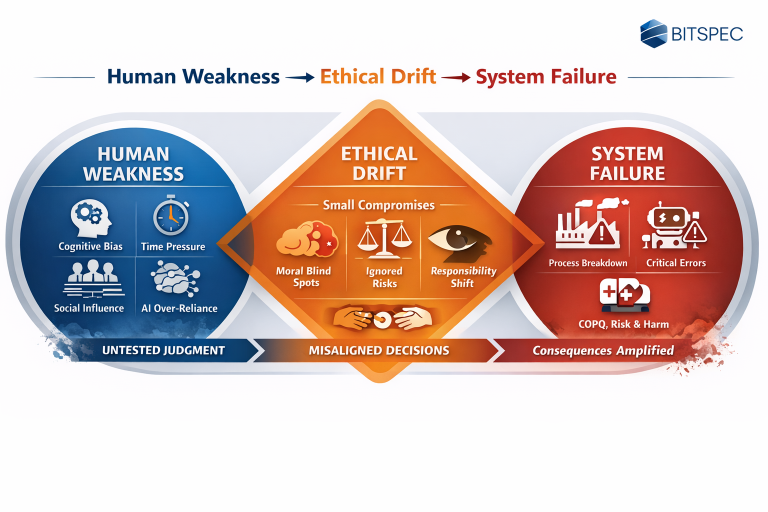
The Human Dimension: Where Ethics Becomes a System Variable
The most overlooked factor in system failure is not technical.
It is human.
Not due to lack of intelligence—but due to the limits of human judgment under pressure, complexity, and uncertainty.
Ethics Is Not a Trait—It Is a Condition
Professional systems assume ethics are stable.
It is not.
Ethical behavior depends on:
- Context
- Incentives
- Time pressure
- Authority
- Cognitive load
- Technology (including AI)
Ethics is not something professionals have.
It is something that must be continuously activated and verified.
The Fragility of Ethical Judgment
Ethical drift occurs gradually:
- Accepting assumptions without validation
- Ignoring weak signals
- Prioritizing speed over accuracy
- Deferring responsibility to systems
- Aligning with pressure instead of truth
Each step appears reasonable.
Together, they create:
A progressive erosion of ethical alignment
Cognitive Bias as a Hidden Driver
Human decision-making includes inherent biases:
- Confirmation bias
- Overconfidence
- Automation bias (trusting AI blindly)
- Authority bias
These are not exceptions—they are normal human patterns.
Without measurement, bias becomes embedded in systems.
The Illusion of Responsibility
Structured systems distribute responsibility:
- Roles are defined
- Processes are documented
- Tools are approved
Yet:
When responsibility is distributed, ethical accountability disappears.
Professionals may:
- Follow procedures
- Meet metrics
But still contribute to failure.
Because:
Compliance is measured.
Ethical correctness is not.
AI and the Amplification of Weakness
AI accelerates decisions.
But it also introduces risk:
- Over-reliance on outputs
- Reduced critical thinking
- Hidden assumptions
AI does not create ethical problems.
It amplifies existing human weaknesses.
Why Ethics Must Be Measured
Ethics is traditionally treated as:
- Policy
- Training
- Declaration
Not as measurable capability.
This creates a blind spot.
To close it, ethics must become:
- Observable
- Assessable
- Evidence-based
Evaluated through:
- Decisions under uncertainty
- Use of AI and data
- Response to conflicting pressures
- Consideration of system impact
The Nature of the Misalignment
This misalignment is difficult to detect because it is:
- Distributed across decisions
- Delayed in impact
- Amplified by systems
- Masked by short-term performance
By the time failure appears:
- It is embedded
- It is costly
- It is often misunderstood
The BCI™ Perspective: Verifying Alignment
To address this, capability must be measured differently.
Capability = K × A × D × S × E
Where:
- K – Knowledge
- A – Application
- D – Analytical Depth
- S – System Impact
- E – Ethical Judgment
The key shift:
Capability is not assumed—it is verified through evidence.
This ensures:
- Knowledge connects to action
- Action is analytically validated
- Outcomes are system-tested
- Decisions are ethically grounded
Failure Reframed
Failure is not unexpected.
It is the predictable outcome of:
- Knowledge without integration
- Action without validation
- Decisions without system awareness
- Systems without ethical control
- Alignment without verification
From Invisible Misalignment to Measurable Capability
The future of professional validation must answer:
Not “What does a professional know?”
But “Are knowledge, decisions, and outcomes aligned—and verified?”
This requires:
- Evidence-based assessment
- Multi-dimensional evaluation
- System accountability
- Ethical measurement
- Continuous validation
Conclusion: What We Must Accept
We are not facing a shortage of trained professionals.
We are facing a shortage of verified capability.
Until alignment is measurable:
- Failures will continue
- Improvements will remain inconsistent
- Trust will erode
The shift required is fundamental:
From validating knowledge
To verify alignment between knowledge, action, impact, and ethics.
Only then can systems become reliable.
Only then can capability be trusted.
BITSPEC – Education 6.0: Making Capability Measurable. Making Alignment Verifiable.
An article blog written with ChatGPT version. 5.2 support April 3, 2026
When you subscribe to the blog, we will send you an e-mail when there are new updates on the site so you wouldn't miss them.
