
Bitspec
Day 2 Competence vs Knowledge: Why Modern Systems Fail Despite ‘Trained’ Professionals
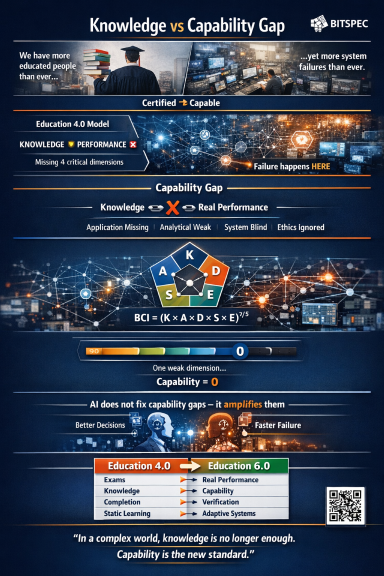
Image generated by ChatGPT version 5.2 (Fast)
Art Perspective + Systems Thinking
There is a silent contradiction shaping modern society:
We have never had more educated people, yet we have never experienced more operational failures in complex systems.
From manufacturing breakdowns to healthcare errors, from aviation incidents to digital system collapses — the pattern is not random.
It is systemic.
It is not a failure of knowledge.
It is a failure of capability.
The Illusion of Competence
Modern education and certification systems are built on a flawed assumption:
If a person knows something, they can perform it.
This assumption no longer holds.
Today’s systems are:
-
Interconnected
-
Dynamic
-
Data-driven
-
AI-influenced
-
High-risk
Yet most professionals are trained through:
-
Static content
-
Standardized exams
-
Memorization-based evaluation
This creates a dangerous illusion:
Certified ≠ Capable
Where Systems Actually Fail
Failures do not occur at the level of theory.
They occur at the intersection of:
-
Decision-making under pressure
-
Interpretation of incomplete or conflicting data
-
Ethical judgment
-
System-wide impact awareness
These are not knowledge problems.
These are capability problems.
The Missing Dimensions of Professional Performance
Traditional education measures only one dimension:
-
Knowledge (K)
But real-world performance depends on a multidimensional system:
-
K — Knowledge (What you know)
-
A — Application (What you can do)
-
D — Analytical Depth (How well you think)
-
S — System Impact (Understanding consequences)
-
E — Ethical Judgment (Making responsible decisions)
When any one of these dimensions is weak, system failure becomes likely.
The BCI™ Model (Education 6.0 Foundation)
At BITSPEC, capability is not assumed — it is measured.
The BITSPEC Capability Index (BCI™) defines professional capability as:
Capability = (K × A × D × S × E)^(1/5)
This model reflects a fundamental truth:
Capability is multiplicative, not additive
-
If Ethical Judgment = 0 → Capability collapses
-
If Application is weak → Knowledge becomes irrelevant
-
If System Impact is ignored → decisions create harm
This explains why highly educated systems still fail.
Why AI Makes This Problem Urgent
Artificial Intelligence amplifies both:
-
Human capability
-
Human error
Without strong capability:
-
AI produces misleading outputs
-
Decisions are made without understanding context
-
Risks scale faster than ever before
AI does not replace capability.
It exposes its absence.
The Shift to Education 6.0
We are entering a new phase:
From:
-
Knowledge-based education
To: -
Capability-based accreditation
From:
-
Course completion
To: -
Verified performance
From:
-
Static learning
To: -
Adaptive, system-aware thinking
This is Education 6.0.
Closing Reflection (Art + Philosophy)
A system is only as strong as the decisions made within it.
And decisions are only as good as the capability behind them.
We must stop asking:
“What do people know?”
And start asking:
“What are people capable of doing — responsibly, analytically, and systemically?”
Because in a complex world, knowledge alone is no longer enough.
Article blog written with ChatGPT ver. 5.2 support March 30, 2026
When you subscribe to the blog, we will send you an e-mail when there are new updates on the site so you wouldn't miss them.
