
Bitspec
Day 19 — Control Without Protection
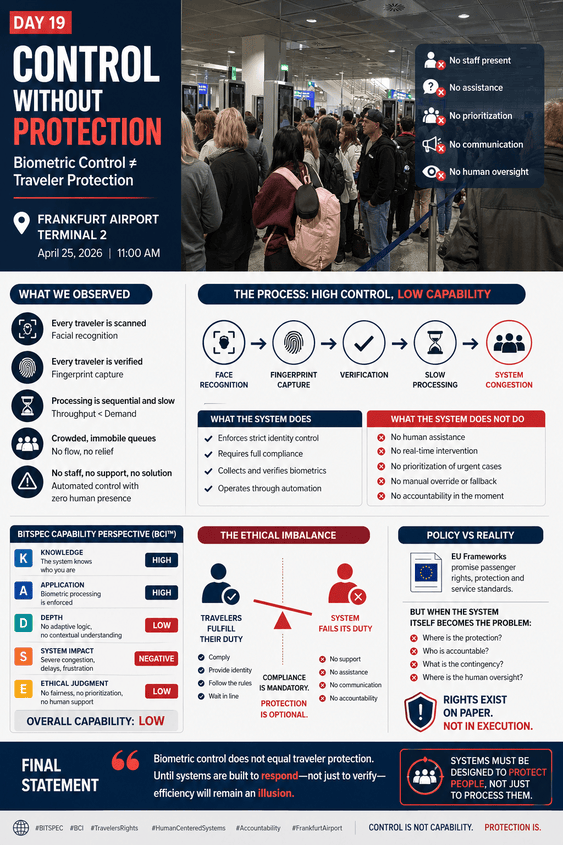
Evidence from Frankfurt Airport (Terminal 2, April 25, 2026 – 11:00 AM)
At 11:00 AM on April 25, 2026, in Terminal 2 of Frankfurt Airport, hundreds of travelers stood in a dense, immobile queue.
Each individual was required to pass through biometric verification: facial recognition and fingerprint capture.
There were no visible staff managing the process.
No intervention.
No prioritization.
No support.
Only machines.
What We Observed?
The system was operational—but not functional.
* Travelers were processed sequentially through biometric checkpoints
* Throughput was significantly lower than demand
* No manual override or contingency flow was visible
* No personnel were present to assist or regulate the situation
The result was not a delay.
It was a systemic bottleneck with no recovery mechanism.
The Illusion of Modernization
Biometric systems are often presented as symbols of efficiency, security, and technological advancement.
In practice, what we observed was different:
* Identity verification was strict
* Control mechanisms were enforced
* Compliance was required from every traveler
Yet when the system slowed down, **there was no corresponding layer of protection**.
> Control was present.
> Capability was not.
The Missing Layer: Human Responsibility
A resilient system is not defined by its level of control, but by its ability to adapt under stress.
In this case:
* No human intervention was available
* No prioritization logic was applied (families, delays, connections)
* No communication or guidance was provided
This represents a failure of operational governance, not just a technical issue.
Automation replaced presence—but did not replace responsibility.
Policy vs Reality
European frameworks emphasize passenger rights, protection, and service standards.
However, what happens when disruption is not a cancellation—but a system failure within control infrastructure?
Where is the protection when:
* Travelers are compliant with all procedures
* Systems enforce strict identity controls
* But no mechanism exists to support or assist during breakdown
> Rights exist in documentation.
> But not in execution.
BITSPEC Capability Perspective (BCI™)
This situation can be evaluated through the Capability Index framework:
Knowledge (K): The system accurately identifies individuals
Application (A): Biometric processing is enforced
Depth (D):No adaptive logic or contextual decision-making
System Impact (S): Severe congestion and operational breakdown. Costs increased
Ethical Judgment (E):No fairness, no prioritization, no human support
Result:
A system with high control and low capability.
> Capability is not measured by what a system enforces.
> It is measured by how it performs under pressure.
Ethical Imbalance
Travelers fulfilled all requirements:
* Identity verification
* Procedural compliance
* Physical presence within the system
Yet the system did not fulfill its responsibility in return.
This creates a fundamental imbalance:
> Compliance is mandatory.
> Protection is optional.
Conclusion
The scene at Frankfurt Airport Terminal 2 is not an isolated inconvenience.
It is a visible manifestation of a broader issue:
Systems are being optimized for control, not for resilience.
Automation is replacing human presence without replacing human accountability.
And when disruption occurs, the traveler is left alone within a system designed to process—but not to protect.
Final Statement
This is not a failure of technology.
It is a failure of design.
> Biometric control does not equal traveler protection.
> Until systems are built to respond—not just to verify efficiency will remain an illusion.
When you subscribe to the blog, we will send you an e-mail when there are new updates on the site so you wouldn't miss them.
