
E-learning emerged with the rise of Web 2.0. The conventional eLearning system was delivered to students by using instructional packets and assignments that were then evaluated by teachers/professors. Web 3.0 introduced Mobile Learning, which is more convenient, hence BITSPEC has adapted the software and IT platform to offer both types of learning.
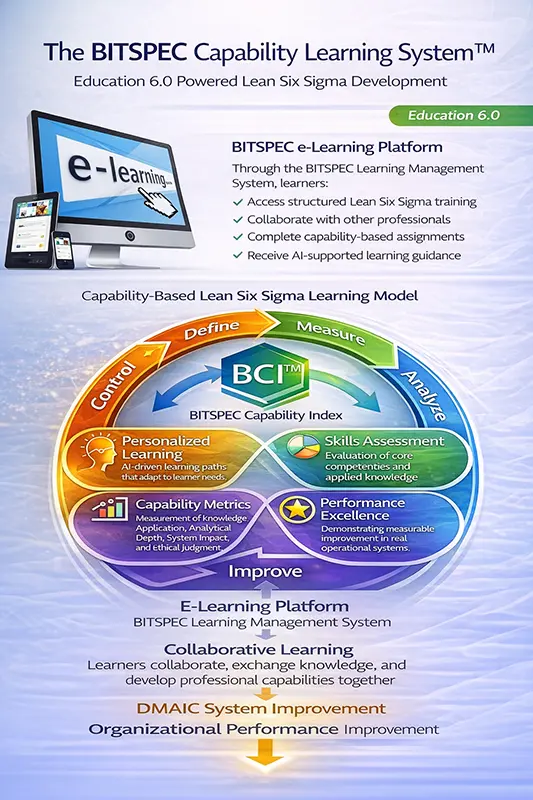 E-Learning 3.0 places the emphasis on social learning and the use of social interaction through blogs, podcasts, virtual worlds, Forums, and Social media. BITSPEC encourages students to become self-directed learners, as capable people are more likely to be able to deal effectively with the changing environment, know how to learn, and have the ability to use their competencies in difficult situations while working with others.
E-Learning 2.0 and 3.0 assume that knowledge (as meaning and understanding) is socially constructed. Although eLearning has a heuristic characteristic, due to our social engagement, we create a different environment that goes beyond the Lean Six Sigma hard skills and knowledge. We aim to enlarge the cognitive foundation through human experiences.
Learning takes place through conversations initiated by students about the content and grounded interaction regarding theoretical concepts and problems, while learning from each other. We believe in eLearning as a 21st-century way to acquire exceptional training and in-depth subject insight, by developing meta-cognitive thinking, collaborative, and research skills. We encourage discussions and interactions among students who are taking our courses while ensuring that our accredited trainers and forum moderators are fully engaged in answering the questions.
New Leaders need to develop their own personal creative competence, while from an organizational point of view, they will need to learn how to coordinate and channel the information and knowledge according to personal and organizational goals. This is eLearning with Web 4.0, when the use of artificial intelligence and machine learning technology is fully implemented.
BITSPEC has an LMS Moodle AI platform, so we operate in the WEB 4.0 environment by interacting with OpenAI. Try our Tutor Bitspec Assistant to help you on the learning journey!
BITSPEC proposes that Lean Six Sigma (DMAIC) serves as a Cognitive Operating System for Education 6.0, ensuring measurable capability development aligned with ethical governance and UNESCO MIL frameworks. Education must transition:
-From certification of time
To validate the capability.
-From content coverage
To cognitive mastery.
-From static curricula
To continuous system improvement.
Beyond Exam-Based Certification
Many certification models rely on standardized testing as the primary measure of competence. While knowledge is important, it does not fully represent a professional’s ability to analyze systems, solve complex problems, or implement sustainable improvements.
BITSPEC certification programs extend beyond exam-based evaluation by incorporating:
• applied analytical work
• real-world problem-solving
• system-level impact assessment
• ethical and responsible decision-making
Certification decisions are based on documented evidence of capability rather than examination performance alone.
This ensures that BITSPEC-certified professionals demonstrate competence that is relevant, measurable, and applicable in real operational environments.
BITSPEC and the Education 6.0 Model
BITSPEC applies the Education 6.0 model to support professionals working in complex operational environments where analytical capability, system thinking, and responsible decision-making are essential. Through the integration of digital learning platforms, AI-assisted analytical tools, and the BITSPEC Capability Index (BCI™), BITSPEC certification programs evaluate professional capability using evidence-based methods rather than relying solely on traditional examinations.
This approach enables learners to demonstrate practical competence in analyzing systems, interpreting data, and implementing measurable improvements in real organizational contexts.