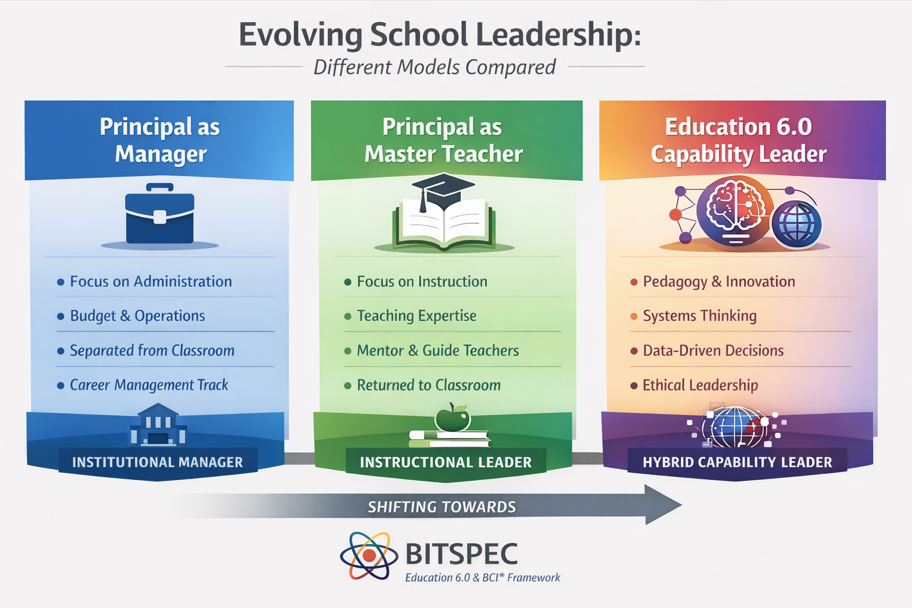
Education systems around the world organize school leadership in very different ways.
In some countries, principals are considered senior educators within the teaching profession, while in others they function primarily as administrative managers of institutions.
This distinction may seem small, but it significantly influences school culture, teacher development, and educational outcomes.
Understanding these models helps explain how leadership structure affects the quality, stability, and long-term performance of education systems.
Two Dominant Models of School Leadership
Globally, two major models of school leadership exist.
1. The Master-Teacher Leadership Model
Countries such as Greece, Finland, and Japan follow a model where principals are first and foremost experienced teachers.
School leaders remain part of the educational profession, and leadership is considered an extension of teaching expertise.
Key characteristics:
-
Principals are selected from experienced teachers
-
They often continue teaching or mentoring
-
Leadership is considered a temporary professional duty
-
Principals may return to teaching roles later
-
Authority is based on pedagogical expertise
This model emphasizes that schools are learning communities, not simply organizations to be managed.
2. The Administrative Manager Model
In countries such as Canada, the United States, and parts of the UK, school principals function primarily as institutional managers.
They often transition into a separate career track that focuses heavily on:
-
budgeting
-
compliance
-
reporting
-
operations management
-
staffing administration
Key characteristics:
-
principals often stop teaching entirely
-
leadership becomes a separate administrative profession
-
emphasis on management training rather than teaching mastery
-
long-term career progression in school administration
This model treats schools more like complex organizations requiring operational management.
Why the Master-Teacher Model Developed
Many European and Asian education systems were historically designed around the idea of an educational corps, similar to professional guilds.
Teachers belonged to a professional body, and leadership roles emerged from within that body.
This philosophy assumes:
-
educational leadership should come from deep instructional expertise
-
teachers respect leaders who understand classroom realities
-
school improvement depends on pedagogical guidance rather than managerial control
Finland and Japan are often cited as strong examples of this approach.
Advantages of the Master-Teacher Model
Several benefits are associated with this leadership structure.
Strong instructional leadership
Principals can guide curriculum, assessment, and pedagogy because they fully understand the teaching process.
Higher teacher trust
Teachers are more likely to trust leaders who have demonstrated excellence in teaching.
Professional culture
Schools function more like collaborative learning environments than hierarchical bureaucracies.
Long-term educational focus
Decisions tend to prioritize student learning and instructional quality rather than short-term administrative metrics.
Advantages of the Administrative Model
The administrative model also offers important strengths.
Strong organizational management
Schools are complex institutions requiring expertise in:
-
finance
-
infrastructure
-
legal compliance
-
personnel management
Strategic planning
Administrative leaders often receive specialized training in:
-
leadership
-
policy implementation
-
institutional governance
Scalability
This model can support large school systems where administrative complexity is high.
The Hidden Risk in Both Models
Both systems also have weaknesses.
Risk in the Master-Teacher Model
Principals may receive limited management training, making it harder to manage budgets, staffing conflicts, or policy requirements.
Risk in the Administrative Model
Principals may become detached from classroom realities, which can lead to:
-
policies that do not work in practice
-
teacher disengagement
-
loss of instructional focus
Toward a New Model of Educational Leadership
Modern education systems increasingly require leaders who combine both capabilities:
-
Deep pedagogical expertise
-
Strong systems leadership and management
In other words, the future of education leadership may require hybrid professionals who understand both learning systems and organizational systems.
This aligns with emerging models such as capability-based education frameworks, where leadership competence includes:
-
instructional leadership
-
analytical decision-making
-
system performance management
-
ethical and sustainability judgment
Education Leadership in the Era of Capability-Based Learning
As education evolves toward Education 6.0, leadership must also evolve.
Schools increasingly operate within complex ecosystems involving:
-
digital learning platforms
-
AI-assisted instruction
-
interdisciplinary collaboration
-
competency-based assessment
-
global knowledge networks
In this environment, the most effective school leaders will be those who can integrate:
-
educational expertise
-
data-driven decision making
-
systems thinking
-
ethical governance
Leadership, therefore, becomes less about authority and more about the capability to guide complex learning systems.
Final Reflection
The question is no longer whether principals should be teachers or managers.
The real challenge is preparing leaders who can function as educational system architects—professionals capable of improving learning, supporting teachers, and managing complex institutions simultaneously.
Education systems that succeed in developing such leaders will likely be better positioned to meet the demands of the rapidly changing knowledge economy.
Dorina Grossu is the co-founder of BITSPEC and a member of the UNESCO Media and Information Literacy Alliance. Her work focuses on capability-based education, AI-assisted learning systems, and professional competency development.
Blog written with the support of OpenAI, ChatGPT (GPT-5.2 Instant), Mar 15, 2026