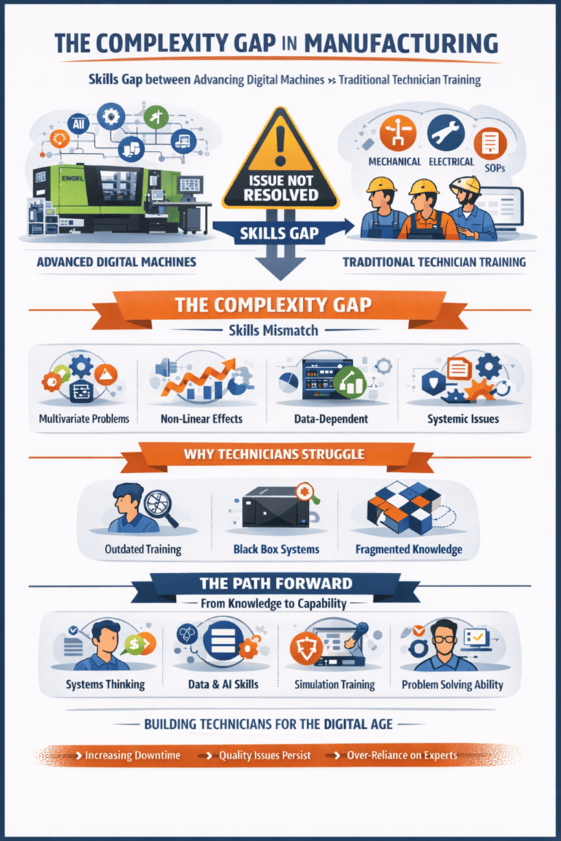
Image generated GPT-5.2 Instant
In modern manufacturing environments, the increasing complexity of digital machines has quietly outpaced the evolution of workforce training. What was once a domain of mechanical troubleshooting has transformed into a highly integrated ecosystem of software, sensors, automation logic, data systems, and AI-assisted controls. This shift has created a structural gap: machines are becoming exponentially smarter, while technician training often remains linear, fragmented, and insufficient for the realities on the shop floor.
Take, for example, advanced injection molding systems such as those produced by ENGEL. These machines are no longer just mechanical presses—they are cyber-physical systems. They incorporate real-time process monitoring, closed-loop control systems, predictive maintenance algorithms, and integration with MES/ERP platforms. A single defect in output quality may no longer be traced to a simple mechanical failure, but rather to a complex interaction between temperature gradients, software parameters, sensor calibration, material variability, and even upstream data inputs.
Yet, many technicians are still trained within traditional frameworks:
- Mechanical troubleshooting
- Basic electrical diagnostics
- Standard operating procedures (SOPs)
These competencies, while still necessary, are no longer sufficient.
The Complexity Gap
The issue is not a lack of effort from technicians—it is a mismatch between system complexity and cognitive preparation.
Modern manufacturing problems are:
- Multivariate (multiple interacting variables)
- Non-linear (small changes produce disproportionate effects)
- Data-dependent (requiring interpretation of large datasets)
- Systemic (root causes span across processes, not isolated components)
However, training programs often:
- Focus on component-level understanding, not system-level thinking
- Emphasize compliance (SOPs) rather than diagnostic reasoning
- Do not integrate data analytics, AI interpretation, or digital literacy
- Rarely simulate real-world failure complexity
As a result, when a complex issue arises, technicians may:
- Escalate prematurely
- Apply trial-and-error fixes
- Misinterpret symptoms as root causes
- Depend heavily on OEM support
This is frequently observed with high-end equipment: technicians from OEMs like ENGEL are expected to resolve issues, yet even they may struggle when the problem exceeds predefined diagnostic pathways. The issue is not individual capability—it is the absence of a structured capability framework aligned with modern system complexity.
Why Complexity Is Increasing Faster Than Capability
There are three main drivers:
- Digitalization without Educational Transformation
Industry has rapidly adopted Industry 4.0 technologies, but education systems have not transitioned at the same pace. Training still reflects an “industrial 2.0–3.0 mindset.” - Hidden Knowledge Layers
Many systems operate as “black boxes.” Technicians interact with interfaces, not underlying logic. Without understanding control algorithms or data models, troubleshooting becomes superficial. - Fragmented Learning Pathways
Skills are taught in isolation: electrical, mechanical, software—rarely integrated into a unified system perspective.
The Real Risk: Operational Blind Spots
This gap creates significant risks:
- Increased downtime due to unresolved root causes
- Quality issues that reoccur despite “fixes”
- Over-reliance on external experts
- Inability to leverage machine intelligence (AI features remain unused)
Most importantly, organizations begin operating systems they do not fully understand.
Moving Toward Capability-Based Training
To address this, training must evolve from knowledge-based to capability-based.
A technician in a modern manufacturing environment must develop:
- Knowledge (K): Understanding of systems, not just components
- Application (A): Ability to apply tools in real scenarios
- Analytical Depth (D): Diagnose multivariate problems
- System Impact (S): Understand upstream/downstream effects
- Ethical Judgment (E): Use AI and automation responsibly
This aligns with frameworks such as your BCI™ model, where competence is not measured by what someone knows, but by what they can resolve in complex, real-world systems.
The Way Forward
Organizations must rethink technician development:
- Introduce systems thinking and DOE-based diagnostics
- Integrate data literacy and AI-assisted analysis
- Use simulation-based training for complex failure scenarios
- Shift from SOP adherence to problem-solving capability
- Build internal expertise instead of relying solely on OEMs
Final Reflection
The challenge is not that machines are too complex. The challenge is that we continue to train people for a simpler world that no longer exists.
Until education and training evolve to match the true nature of digital manufacturing systems, even the most advanced machines will operate below their potential—not because of technical limitations, but because of human capability constraints.
Blog written with the support of OpenAI, ChatGPT (GPT-5.2 Instant), Mar 27, 2026