Abstract
Organizations today operate in environments saturated with data, dashboards, and artificial intelligence. Yet, despite unprecedented access to information, poor decisions persist across industries.
This paradox reveals a critical issue: the Decision Gap—the disconnect between having data and making the right decision.
While classical decision-making models explain how humans make decisions, they do not explain why decisions fail in modern, data-rich environments.
This article extends established ethical decision-making theory by introducing the BITSPEC Capability Index (BCI™) as a measurable framework for decision quality in the era of AI and complex systems.
1. Introduction: The Illusion of Data-Driven Organizations
Modern organizations proudly claim to be data-driven.
They invest in:
- Advanced analytics
- AI-enabled systems
- Real-time dashboards
- Predictive models
Yet failures continue:
- Strategic misalignment
- Ineffective improvement initiatives
- Ethical breakdowns
- System-level inefficiencies
The problem is not lack of data.
The problem is the inability to make correct decisions from data.
2. Theoretical Foundation: How Decisions Are Traditionally Understood
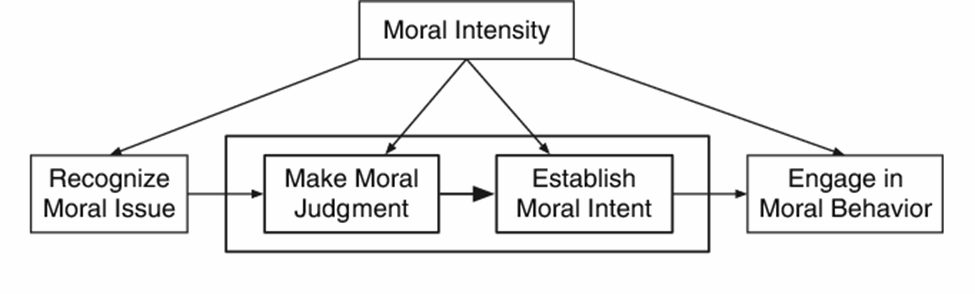
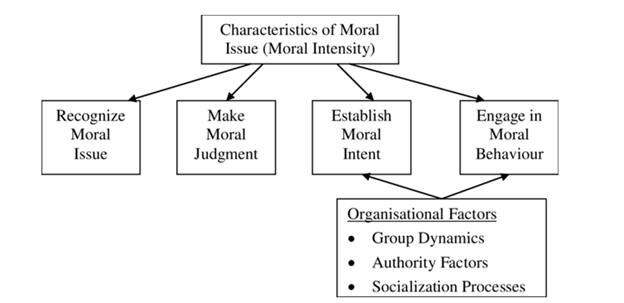
Schwartz, M.s & Kusyk, Sophia. (2017). Ethical Decision-Making Theory: Revisiting the Moral Intensity Construct. Academy of Management Proceedings. 2017. 16266. 10.5465/AMBPP.2017.16266abstract.
Classical ethical decision-making models—particularly those developed by James Rest and Thomas M. Jones—describe decision-making as a structured process:
- Awareness (Recognize the issue)
- Judgment (Evaluate what is right)
- Intention (Commit to action)
- Behavior (Act)
These models also introduce:
- Moderating factors (individual moral capacity, situational context)
- Internal processing (emotion, intuition, reasoning, justification)
- Learning loops (retrospective reflection)
Limitation of Classical Models
These models explain:
✔ Human cognition
✔ Ethical reasoning
But they do NOT explain:
❌ Why decisions fail in data-rich environments
❌ How analytical depth is measured
❌ How system impact is evaluated
❌ How AI influences decision-making
This is where the Decision Gap emerges.
3. The Decision Gap
The Decision Gap is the disconnect between:
- Data availability
- Data interpretation
- Decision-making
- System-level impact
Even when organizations:
- Have accurate data
- Use advanced analytics
- Apply structured methodologies
They still fail because:
- Decisions lack depth
- Decisions ignore system effects
- Decisions lack ethical grounding
4. Extending the Model: The BITSPEC Contribution (BCI™)
Classical ethical decision-making models (e.g., Rest, Jones) describe decision-making as a progression from awareness to behavior. However, these models do not account for capability measurement, AI influence, or system-level impact—gaps addressed by the BITSPEC Decision Model under Education 6.0.
To address these limitations, BITSPEC introduces the Capability-Based Decision Model under Education 6.0, operationalized through the BITSPEC Capability Index (BCI™).
BCI™ Formula
BCI= (K*A*D*S*E
Where:
- K — Knowledge (awareness of the issue)
- A — Application (ability to apply tools and methods)
- D — Analytical Depth (quality of reasoning and interpretation)
- S — System Impact (understanding of cross-functional consequences)
- E — Ethical Judgment (alignment with responsible and sustainable decisions)
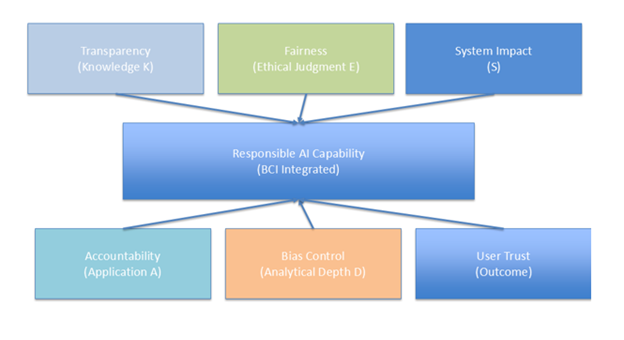
Fig. 1- Ethical AI Capability Model
5. Mapping Classical Theory to BCI™
Classical Model |
BCI™ Extension |
|
Awareness |
Knowledge (K) |
|
Internal Reasoning |
Analytical Depth (D) |
|
Judgment |
System Impact (S) |
|
Intention |
Ethical Judgment (E) |
|
Behavior |
Capability Output |
Key Insight
Classical models describe how decisions are made.
BCI™ measures how well decisions are made.
6. The Role of AI in the Decision Gap
AI introduces a new layer:
✔ Enhances:
- Data processing
- Pattern detection
- Predictive capability
❌ Does NOT guarantee:
- Correct interpretation
- Ethical decisions
- System awareness
AI amplifies the Decision Gap when capability is low.
7. Why Lean Six Sigma Alone Is Not Enough
Lean Six Sigma provides:
- Statistical rigor
- Structured problem-solving
- Analytical tools
Yet failures occur when:
- The wrong problem is selected
- Results are misinterpreted
- Solutions ignore system-wide impact
Tools support decisions—but do not ensure capability.
8. Real-World Implications
Manufacturing
Local optimization → system bottlenecks
Healthcare
Data-driven protocols → poor patient outcomes
Finance
Algorithmic models → systemic risk
Public Systems
Policy decisions → unintended societal effects
9. Education 6.0: Closing the Decision Gap
Education must shift:
From:
- Knowledge-based learning
- Tool-focused training
- Exam-based certification
To:
- Capability verification
- System thinking
- Ethical reasoning
- Decision accountability
Education 6.0 Principle
Capability is demonstrated by the quality of decisions and their impact on systems—not by knowledge alone.
10. Conclusion
The modern world does not suffer from a data shortage.
It suffers from a decision capability deficit.
The true competitive advantage is not data.
It is the ability to make correct, ethical, and system-aware decisions.
BITSPEC Positioning Statement
In Education 6.0, capability is not measured by the ability to generate data, but by the ability to make decisions that improve systems.
Article blog written with ChatGPT ver. 5.2 support April 1, 2026