Image generated ChatGPT ver. 5.2
Why We Certify Knowledge but Fail to Validate Capability
Abstract
Modern education and professional certification systems continue to rely on assessment models that prioritize knowledge recall over demonstrated capability. While learners are increasingly exposed to complex, dynamic environments—particularly with the rise of artificial intelligence (AI) and digital systems—evaluation frameworks remain rooted in outdated industrial paradigms. This paper argues that the primary failure of education is not a lack of learning, but a failure of measurement. It introduces a capability-based perspective and highlights the need for multidimensional evaluation systems that reflect real-world performance. The BITSPEC Capability Index (BCI™) is presented as a model to address this systemic gap.
1. Introduction: A System That Measures the Wrong Thing
Across education and certification systems, success is typically defined by performance on exams, quizzes, and standardized assessments. Learners are evaluated based on their ability to recall information, apply formulas in controlled environments, and reproduce expected answers.
However, real-world performance rarely depends on recall alone.
Professionals today operate in environments characterized by:
- uncertainty
- system complexity
- interdependent variables
- ethical decision-making requirements
Despite this reality, most systems continue to certify individuals based on what they know, rather than what they can do.
This misalignment has created what can be described as a measurement crisis.
We do not have a learning crisis. We have a measurement crisis.
2. The Illusion of Competence
Certification is often interpreted as evidence of competence. A completed course, a passing grade, or a professional designation creates the perception that an individual is capable of performing effectively in real-world conditions.
Yet, this assumption is increasingly flawed.
A learner may:
- pass a statistical exam without being able to interpret real process variation
- complete Lean Six Sigma training without successfully leading an improvement project
- obtain certification without understanding system-wide impact or risk
This disconnect stems from a fundamental issue:
assessment systems measure proxies of competence—not competence itself.
Knowledge is treated as a substitute for capability.
3. The Industrial Legacy of Measurement
The current assessment paradigm is not accidental—it is inherited.
Education systems were originally designed to support industrial-era needs:
- standardization of skills
- efficiency in training large populations
- predictable, repeatable outcomes
These systems emphasized:
- uniform testing
- fixed answers
- compliance with predefined standards
While effective for mass education, this model is insufficient for modern environments where:
- problems are non-linear
- solutions are context-dependent
- performance requires judgment, not repetition
The result is a structural mismatch between:
- what is measured and
- what actually matters
4. Real-World Consequences of the Measurement Gap
The failure to measure capability has tangible consequences across industries.
4.1 Engineering and Manufacturing
Technicians and engineers are increasingly confronted with highly complex digital systems. When failures occur, resolution requires:
- system-level thinking
- root cause analysis beyond surface symptoms
- integration of multiple knowledge domains
Yet, many professionals lack the depth required to respond effectively—not due to lack of exposure, but due to insufficient evaluation of applied capability.
4.2 Management and Decision-Making
Managers often rely on metrics without understanding:
- underlying system dynamics
- unintended consequences of decisions
- long-term impact on organizational performance
Certification does not guarantee the ability to make informed, system-aware decisions.
4.3 Artificial Intelligence and Ethical Risk
With the integration of AI into decision-making processes, a new dimension has emerged:
- ethical judgment
- bias recognition
- responsible use of automated outputs
Current systems rarely assess whether individuals can:
- critically evaluate AI-generated results
- identify ethical risks
- make accountable decisions
The absence of this dimension creates significant organizational and societal risk.
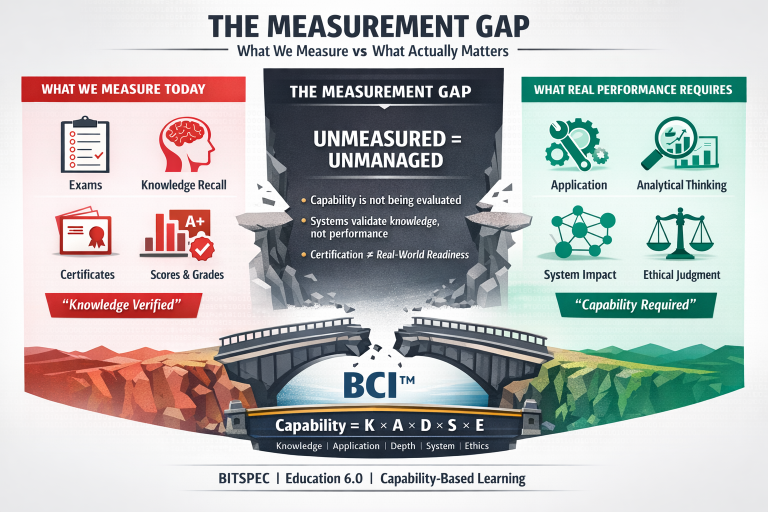
5. What Is Missing from Measurement
To align evaluation with real-world performance, capability must be understood as multidimensional.
Traditional systems primarily measure:
- Knowledge (K)
However, real capability requires additional dimensions:
- Application (A): Ability to use knowledge in real situations
- Analytical Depth (D): Ability to interpret, question, and analyze
- System Impact (S): Understanding of broader organizational consequences
- Ethical Judgment (E): Responsible and informed decision-making
Without these dimensions, assessment remains incomplete.
6. A Capability-Based Perspective: The BCI™ Model
To address this gap, capability can be expressed as an integrated construct:
Capability = Knowledge × Application × Analytical Depth × System Impact × Ethical Judgment
This formulation reflects a critical principle:
Capability is not additive—it is multiplicative.
A deficiency in any one dimension reduces overall capability, regardless of strength in others.
The BITSPEC Capability Index (BCI™) operationalizes this concept by:
- defining measurable criteria for each dimension
- requiring evidence-based assessment
- integrating knowledge and performance into a unified evaluation model
Unlike traditional systems, BCI™ does not assume competence—it requires demonstration.
7. The Role of Artificial Intelligence in Measurement
Artificial intelligence has the potential to transform assessment systems—if used appropriately.
AI can:
- analyze decision-making patterns
- evaluate reasoning processes
- track performance across scenarios
- identify inconsistencies in applied knowledge
However, AI alone is not a solution.
Without a proper framework, AI risks:
- reinforcing flawed metrics
- automating superficial evaluation
- amplifying existing biases
The effectiveness of AI in education depends on the quality of the measurement model it supports.
8. Toward Education 6.0: Measuring What Matters
The transition toward more advanced educational paradigms requires a shift from:
- content delivery → capability development
- knowledge testing → performance validation
- certification → verification
Education 6.0 represents this shift by emphasizing:
- real-world application
- integrated competencies
- measurable impact
In this model, learning is not complete until capability is demonstrated.
9. Conclusion
The challenges faced in modern education and professional certification are not primarily due to insufficient content or lack of access to knowledge.
They are the result of measuring the wrong outcomes.
As long as systems continue to prioritize knowledge over capability:
- certification will remain disconnected from performance
- organizations will face increasing competency gaps
- individuals will be unprepared for real-world complexity
Until we measure what truly matters, we will continue to certify what does not.
Keywords
Capability Measurement, Education 6.0, Professional Certification, Competence, Artificial Intelligence in Education, Lean Six Sigma, BCI™, Assessment Systems, System Thinking, Ethical Judgment
Article blog written with ChatGPT ver. 5.2 support March 31, 2026